CC0 · no rights reserved
Scepter
From the collection of Cleveland Museum of Art. Free to download, adapt and use — no permission needed.
About this work
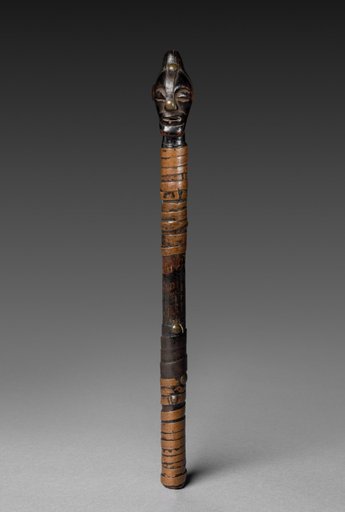
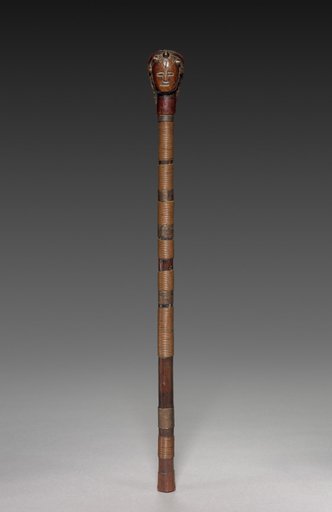
Staffs and scepters as well as tobacco pipes and mortars are among the most important sculptural creations to stem from the Ovimbundu peoples, a Central African culture. All of these object types have associations with ideas of class, status, and power. This scepter has a handle wrapped in thin copper wire that forms wide bands of alternating metal and wooden passages. Its finial is a human head whose carved headdress or hairstyle is ornamented with round-headed metal tacks.
Cleveland Museum of Art’s own descriptionCredit lineScepter, late 1800s or early 1900s. Africa, Central Africa, Angola, Ovimbundu-style maker. Wood, copper alloy, upholstery studs, iron alloy, and cotton; overall: 57.5 x 4.5 x 5.5 cm (22 5/8 x 1 3/4 x 2 3/16 in.). The Cleveland Museum of Art, Gift of Dr. Anita J. Glaze, 2015.155