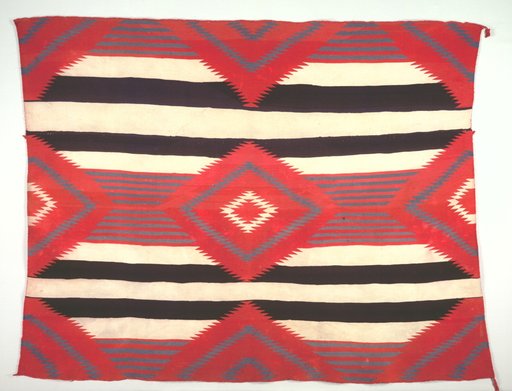
Hubbell Revival-Style Rug with Moki (Moqui) Stripes
From the collection of Cleveland Museum of Art. Free to download, adapt and use — no permission needed.
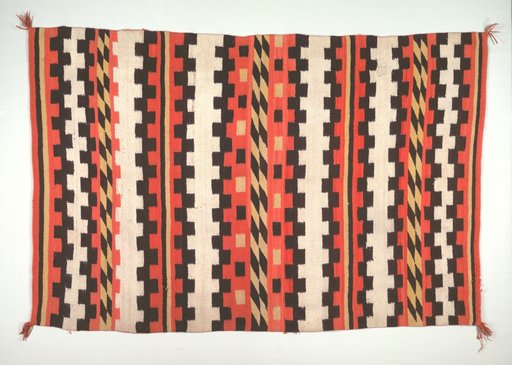
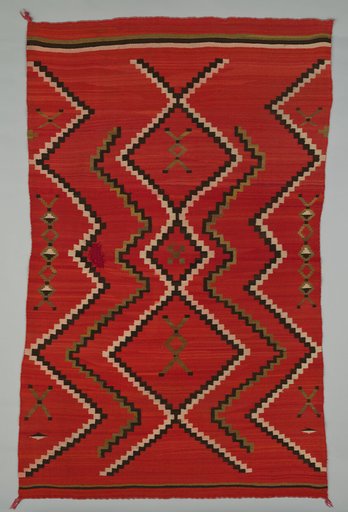
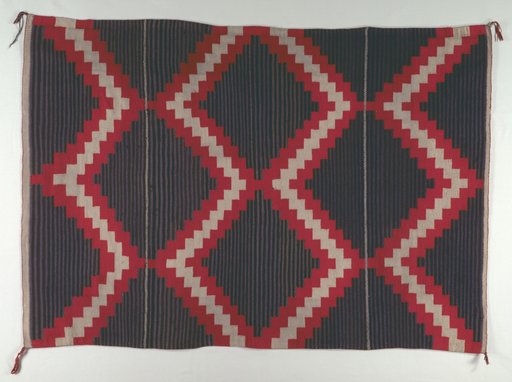
Navajo blankets are splendid microcosms of the Southwest’s cultural richness. This example has two old Navajo designs: the terraced diamond and the striped moki pattern. Moki’s origin is unclear. It may have come from Pueblo peoples, from whom the Navajo learned weaving after migrating to the Southwest from Canada. Or it could have come from the Spaniards, who arrived in the Southwest in 1540, not long after the Navajo. Though the patterns are old, the blanket was created around 1900 when Navajo weavers began to innovate for the Anglo market, and wearing-blankets, which were worn around the shoulders, became rugs sold to outsiders. In Navajo legend, weaving is connected to the mythic Spider-Woman, who on her loom wove the universe from cosmic materials. Weaving, then, is an activity charged with meaning. The Navajo place emphasis not so much on the final product but on the process, which they regard as a means of creating beauty and projecting it onto the world.
Cleveland Museum of Art’s own description