CC0 · no rights reserved
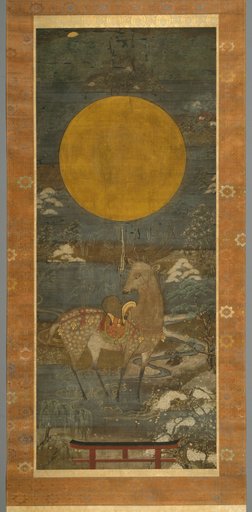
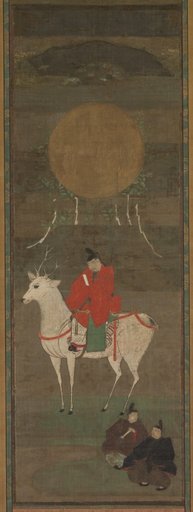
Departure from Kashima
From the collection of Cleveland Museum of Art. Free to download, adapt and use — no permission needed.
About this work
The kami Takemikazuchi from Kashima (in present-day Ibaraki Prefecture) departs on a white deer for Mount Mikasa in Nara, where he takes up residence. The five Kasuga kami are presented within a golden circle supported by the branches of a sakaki tree, from which trail five white paper streamers—indicating the purity and sacredness of the five shrine halls of the complex—as well as blossoming wisteria vines, a symbol of the Fujiwara family. The two figures walking along near the stag’s back legs are Nakatomi no Tokifū and his younger brother Hidetsura, who have followed Takemikazuchi and become priests of Kasuga Taisha.
Cleveland Museum of Art’s own descriptionCredit lineDeparture from Kashima, 1336–92. Japan, Nanbokuchō period (1336–92). Hanging scroll; ink and color on silk; overall: 212.7 x 63.3 cm (83 3/4 x 24 15/16 in.); including mounting: 119.4 x 41 cm (47 x 16 1/8 in.). The Cleveland Museum of Art, The Worcester R. Warner Collection, 1917.93