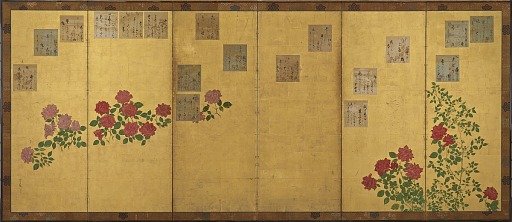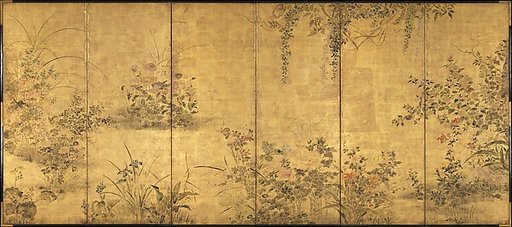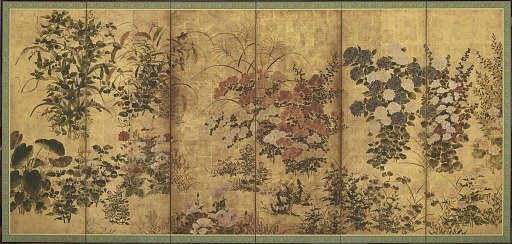
Summer and autumn flowers 夏秋草花図屏風
From the collection of National Museum of Asian Art (Freer/Sackler). Free to download, adapt and use — no permission needed.
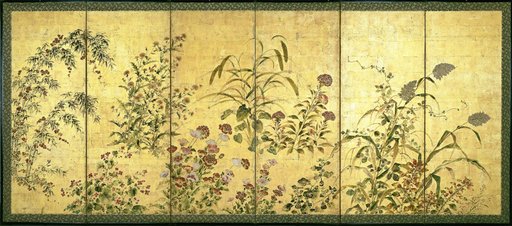
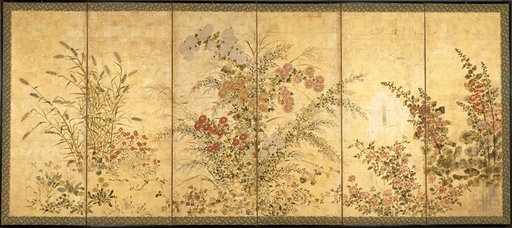
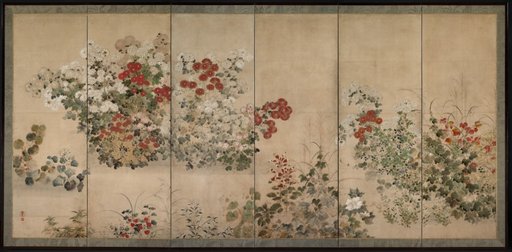
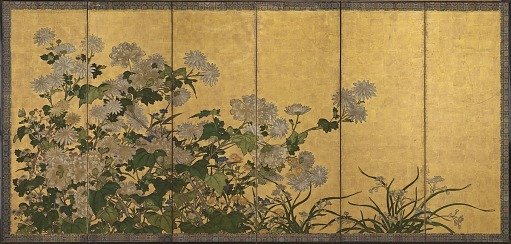
Grains and vegetables--including corn, eggplant, and taro--are unusual additions to this array of seasonal flowers depicted in an imaginary gardenlike setting. From right to left, the blooming or fruiting plants represent a seasonal progression from early spring (bog rhubarb and kerria) to late summer, when ripe wheat and millet mingle with autumn-blooming flowers such as bush clover and Chinese bellflowers. The convention of depicting seasonal plants arranged against a gold ground on folding screens and sliding paper-panelled doors (fusuma) originated in the Kyoto workshop of Tawaraya Sotatsu (active circa 1600-1640) and became a successful mainstay of that studio's repetoire. One hallmark of the Sotatsu style is the use of overlapping wet pigments that blur at the edges, a technique known as tarashikomi.
National Museum of Asian Art (Freer/Sackler)’s own description