CC0 · no rights reserved
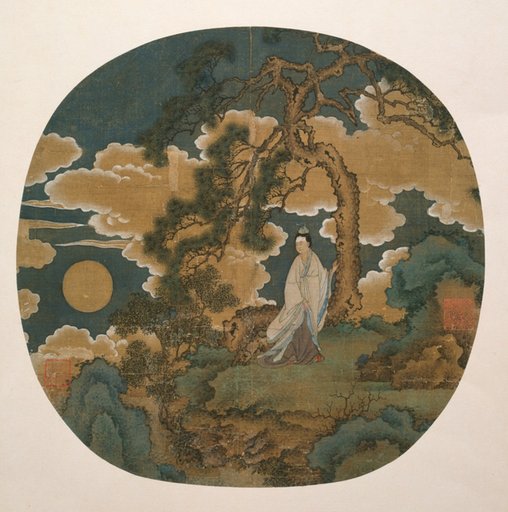
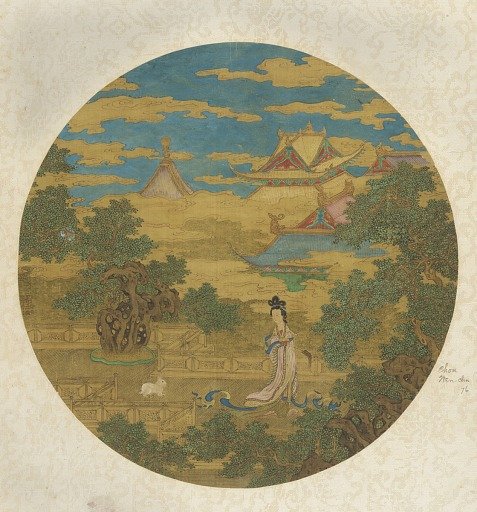
The Goddess Chang'e in the Lunar Palace
From the collection of National Museum of Asian Art (Freer/Sackler). Free to download, adapt and use — no permission needed.
About this work
In primordial times, the legendary hunter Yi once received the elixir of immortality from the great goddess, the Queen Mother of the West. Before he could consume the elixir, however, Yi's wife Chang'e (or Heng'e) stole the concoction and ingested it herself, thereby becoming an immortal. Fearing her husband's wrath, Chang'e fled to the moon, where she dwells for eternity in the Palace of Boundless Cold. Among the many denizens of the moon, the white rabbit, seen beside her on the terrace, is generally shown preparing the elixir of immortality with a mortar and pestle.
National Museum of Asian Art (Freer/Sackler)’s own descriptionSubjects
Credit lineThe Goddess Chang'e in the Lunar Palace. 19th century. Formerly attributed to Zhou Wenju (傳)周文矩 (active mid-10th century). National Museum of Asian Art (Freer/Sackler), Gift of Charles Lang Freer. CC0.