Public domain
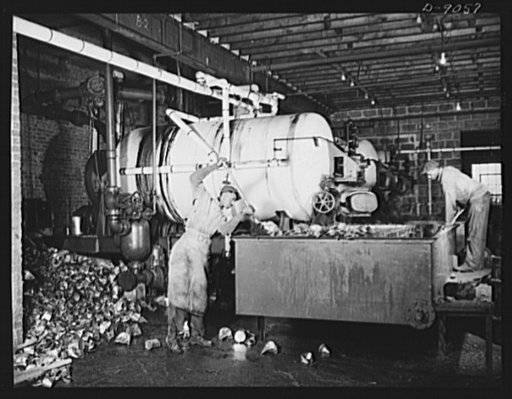
Conversion. Rendering of household fats. Empty cans from which reclaimed household greases have been removed are shoveled from a vat at a rendering plant. The greases will be rendered for the making of soap and glycerin. These cans, often prepared the way the householder does, will be sent to a deti
From the collection of Library of Congress. Free to download, adapt and use — no permission needed.
Credit lineConversion. Rendering of household fats. Empty cans from which reclaimed household greases have been removed are shoveled from a vat at a rendering plant. The greases will be rendered for the making o. 1943-01-01. Palmer, Alfred T., United States. Office Of War Information. Farm Security Administration/Office of War Information Collection, Library of Congress. Public domain.
Similar works
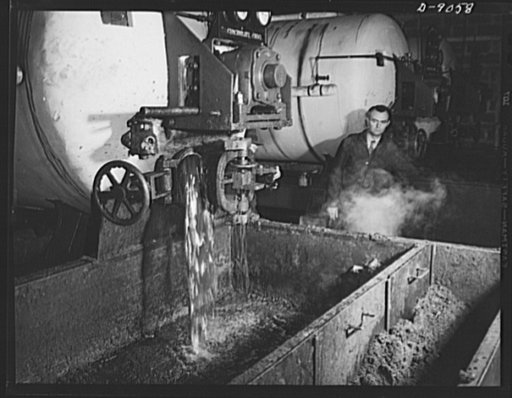 Conversion. Rendering of household fats. Reclaimed household greases from America's kitchens drain into an open vat at a rendering plant. Some of the batches are recooked with additional fats to bring them up to certain specific grades
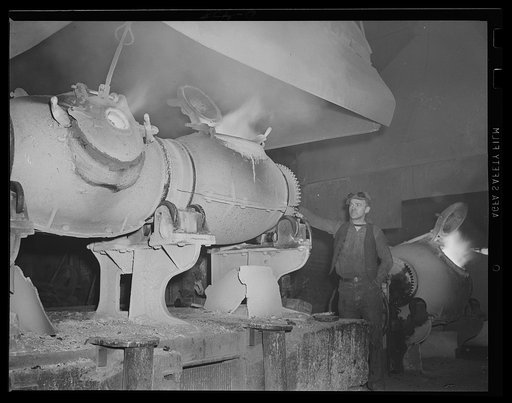 Putting on the heat. Brass ingots are brought to the "boiling" point in fiery furnances at an eastern Navy yard, where production for defense is stepped up to new highs
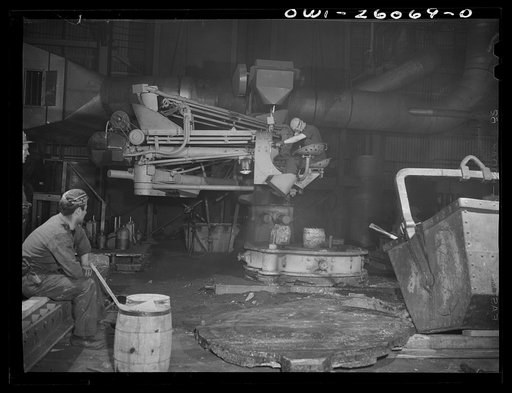 Buffalo, New York. Symington-Gould, makers of tank, ship, and railroad parts. Sand slinger operated by a woman. Sand is forced onto pattern with air pressure. The operator wears safety goggles and a dust-proof noseguard to protect herself from ricocheting sand and must rest every twenty minutes or s
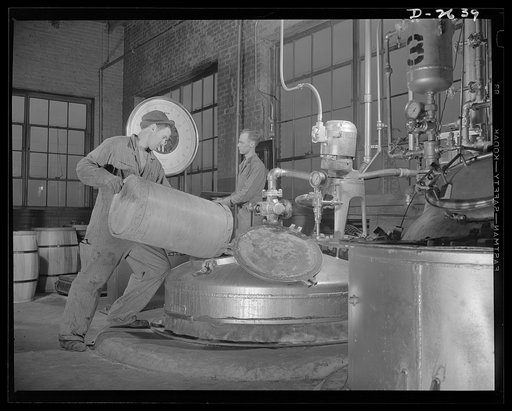 Synthetic rubber (Ameripol). Carefully selected soap is used in the making of solutions used during the manufacture of synthetic rubber. This worker is mixing a solution at the B.F. Goodrich plant, in Akron, Ohio. It is mixed in a nickel-lined tank. Goodrich
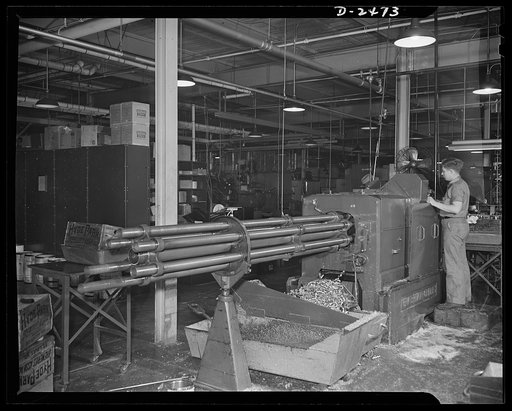 A New Britain-Gridley lathe is worked by an experienced operator at a Midwestern company. The machine which formerly made spur gears, worm wheels and commentator rings has been converted to war use by being tooled with an eccentric spindle and thread rolling attachment for the production of twenty-m
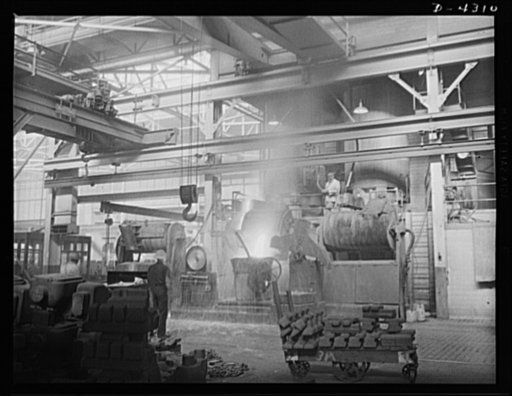 Production. Milling machines and machine castings. This picture shows the general setup on the foundry floor. Notice the overlapping cranes (above and left). Any one of four cranes can come in to pick up full ladles, depending on their size and destination. Location: a large Midwest machine tool fou