Public domain
KSC-03pd1370
From the collection of NASA Image and Video Library. Free to download, adapt and use — no permission needed.
About this work
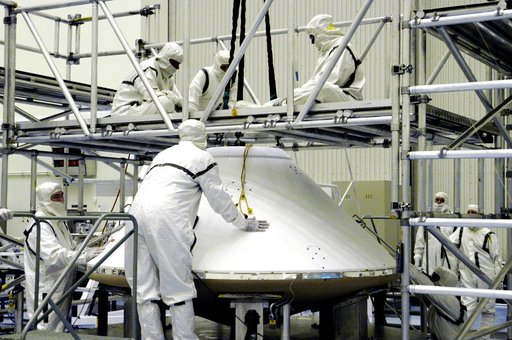
Kennedy Space Center, Fla. — Workers in the Payload Hazardous Servicing Facility look over the aeroshell enclosing Mars Exploration Rover 2 and lander that is being moved to a rotation table for a spin stabilization test. There are two identical rovers that will land at different regions of Mars and are designed to cover roughly 110 yards each Martian day over various terrain.
NASA Image and Video Library’s own descriptionCredit lineKSC-03pd1370. NASA/KSC, 2003-04-29. Public domain. ID: KSC-03pd1370.
Similar works
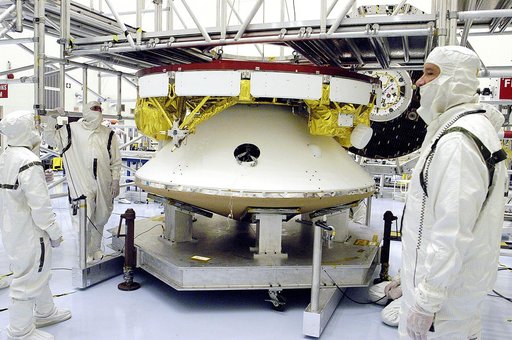 KENNEDY SPACE CENTER, FLA. - The Mars Exploration Rover 2 (MER-2) undergoes a weight and center of gravity determination in the Payload Hazardous Servicing Facility. NASA's twin Mars Exploration Rovers are designed to study the history of water on Mars. These robotic geologists are equipped with a
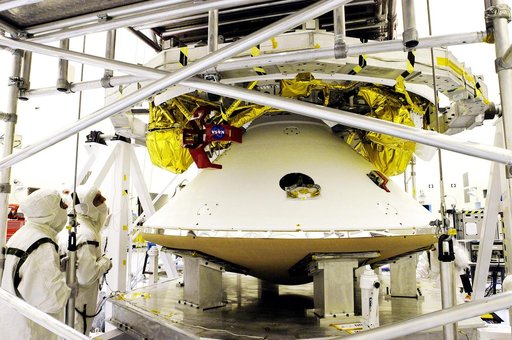 KENNEDY SPACE CENTER, FLA. - The Mars Exploration Rover 1 (MER-1) lander (below) is mated to the cruise stage, seen above the lander. NASA's twin Mars Exploration Rovers are designed to study the history of water on Mars. These robotic geologists are equipped with a robotic arm, a drilling tool, t
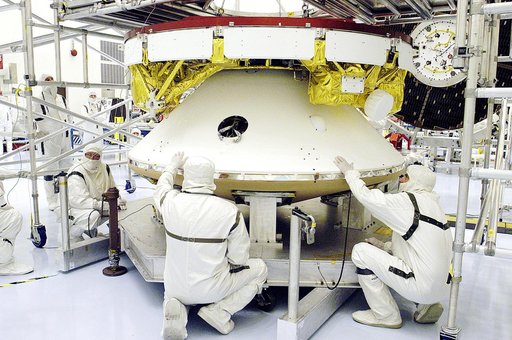 KENNEDY SPACE CENTER, FLA. - The Mars Exploration Rover 2 (MER-2) undergoes a weight and center of gravity determination in the Payload Hazardous Servicing Facility. NASA's twin Mars Exploration Rovers are designed to study the history of water on Mars. These robotic geologists are equipped with a
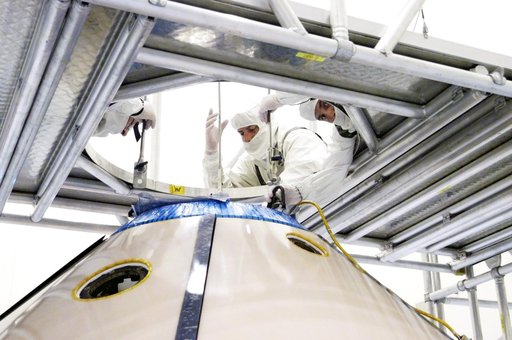 KENNEDY SPACE CENTER, FLA. - Workers attach an overhead crane to the Mars Exploration Rover 1 (MER-1) inside the upper backshell. The backshell will be moved and attached to the lower heat shield. NASA's twin Mars Exploration Rovers are designed to study the history of water on Mars. These robot
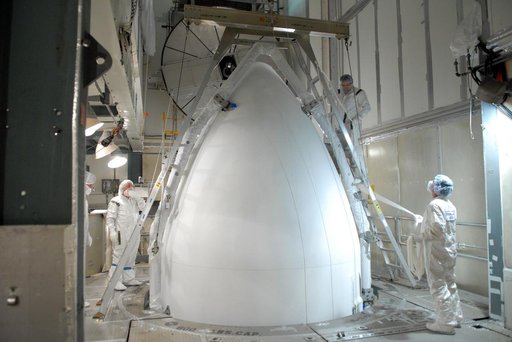 KSC-08pd1440
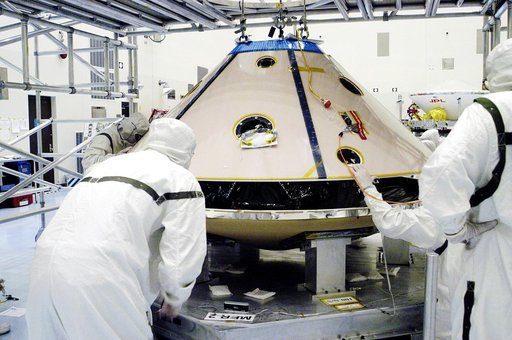 KENNEDY SPACE CENTER, FLA. - In the Payload Hazardous Servicing Facility, workers lower the backshell with the Mars Exploration Rover 1 (MER-1) onto the heat shield. The two components form the aeroshell that will protect the rover on its journey to Mars. NASA's twin Mars Exploration Rovers are de