Public domain
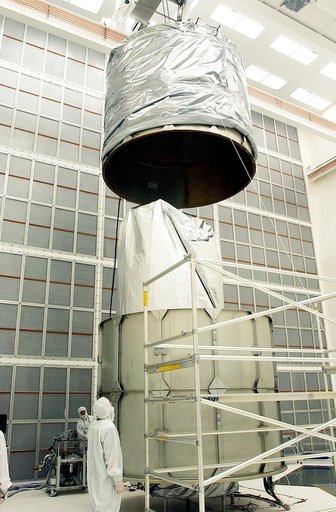
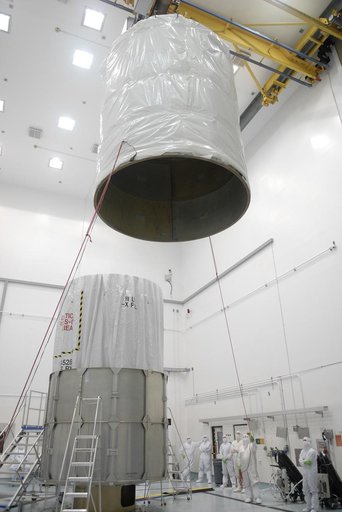
KENNEDY SPACE CENTER, FLA. - Workers at Hangar A&E, Cape Canaveral Air Force Station, lower the upper canister toward the Space Infrared Telescope Facility (SIRTF) below. After encapsulation is complete, the spacecraft will be transported to Launch Complex 17-B for mating with its launch vehicle,
From the collection of NASA Image and Video Library. Free to download, adapt and use — no permission needed.
About this work
Kennedy Space Center, Fla. — Workers at Hangar A&E, Cape Canaveral Air Force Station, lower the upper canister toward the Space Infrared Telescope Facility (SIRTF) below. After encapsulation is complete, the spacecraft will be transported to Launch Complex 17-B for mating with its launch vehicle, the Delta II rocket. SIRTF consists of three cryogenically cooled science instruments and an 0.85-meter telescope, and is one of NASA's largest infrared telescopes to be launched.
NASA Image and Video Library’s own descriptionCredit lineKENNEDY SPACE CENTER, FLA. - Workers at Hangar A&E, Cape Canaveral Air Force Station, lower the upper canister toward the Space Infrared Telescope Facility (SIRTF) below. After encapsulation is complete, the spacecraft will be transported to Launch Complex 17-B for mating with its launch vehicle, the Delta II rocket. SIRTF consists of three cryogenically cooled science instruments and an 0.85-meter telescope, and is one of NASA's largest infrared telescopes to be launched. SIRTF will obtain images and spectra by detecting the infrared energy, or heat, radiated by objects in space. Most of this infrared radiation is blocked by the Earth's atmosphere and cannot be observed from the ground.. NASA/KSC, 2003-08-07. Public domain. ID: KSC-03pd2298.
Similar works
 KSC-03pd0976
 KSC-04pd-2257
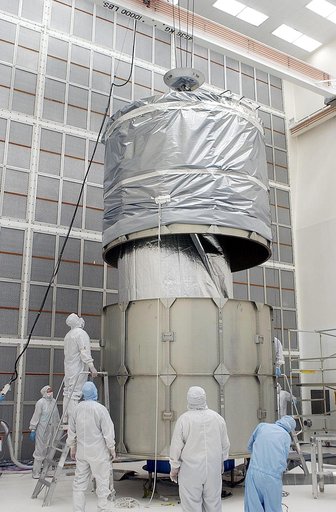
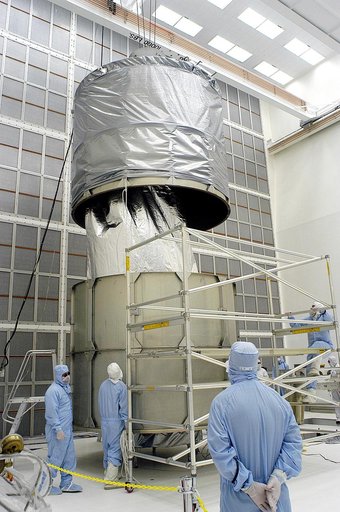 KENNEDY SPACE CENTER, FLA. - Workers in NASA Spacecraft Hangar AE remove a portion of a transportation canister from around the Space Infrared Telescope Facility (SIRTF), which has been returned to the hangar from the launch pad. SIRTF will remain in the clean room until it returns to the pad in
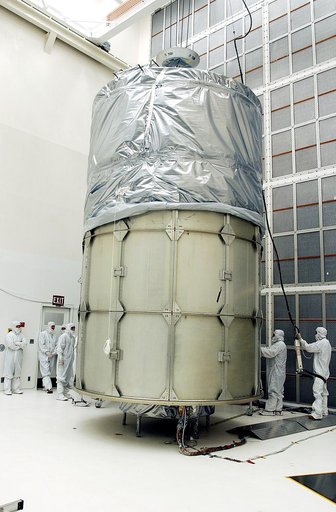 KENNEDY SPACE CENTER, FLA. - In Hangar A&E, Cape Canaveral Air Force Station, encapsulation of the Space Infrared Telescope Facility (SIRTF) is complete. The spacecraft will be transported to Launch Complex 17-B for mating with its launch vehicle, the Delta II rocket. SIRTF consists of three cr
 KSC-2009-5061
 KSC-03pd0979