Public domain
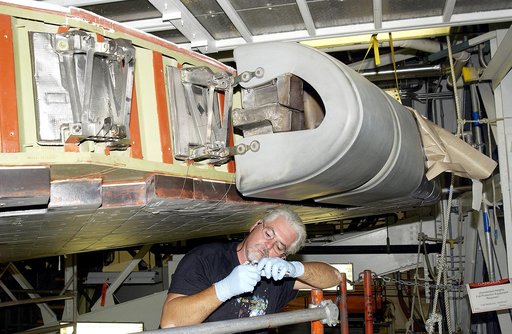
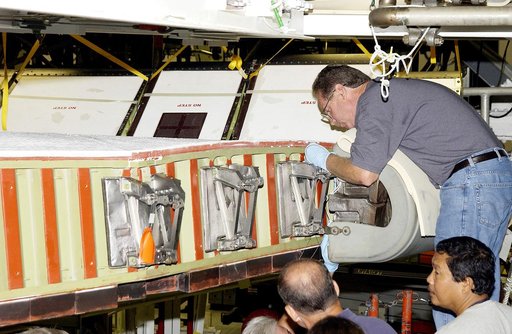
KENNEDY SPACE CENTER, FLA. - Billy Witt, a midbody shop mechanic with United Space Alliance, checks a part used for installation of a Reinforced Carbon Carbon (RCC) panel to the leading edge of the wing of an orbiter. Above him is an RCC panel just installed on Atlantis. The gray carbon composit
From the collection of NASA Image and Video Library. Free to download, adapt and use — no permission needed.
About this work
Kennedy Space Center, Fla. — Billy Witt, a midbody shop mechanic with United Space Alliance, checks a part used for installation of a Reinforced Carbon Carbon (RCC) panel to the leading edge of the wing of an orbiter. Above him is an RCC panel just installed on Atlantis. The gray carbon composite RCC panels have sufficient strength to withstand the aerodynamic forces experienced during launch and reentry, which can reach as high as 800 pounds per square foot.
NASA Image and Video Library’s own descriptionCredit lineKENNEDY SPACE CENTER, FLA. - Billy Witt, a midbody shop mechanic with United Space Alliance, checks a part used for installation of a Reinforced Carbon Carbon (RCC) panel to the leading edge of the wing of an orbiter. Above him is an RCC panel just installed on Atlantis. The gray carbon composite RCC panels have sufficient strength to withstand the aerodynamic forces experienced during launch and reentry, which can reach as high as 800 pounds per square foot. The operating range of RCC is from minus 250º F to about 3,000º F, the temperature produced by friction with the atmosphere during reentry.. NASA/KSC, 2003-09-08. Public domain. ID: KSC-03pd2606.
Similar works
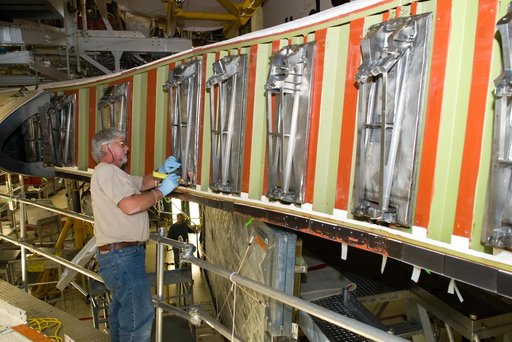
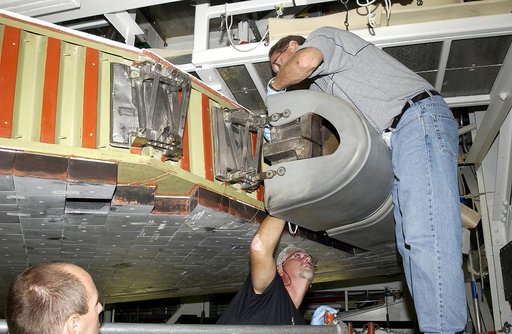 KENNEDY SPACE CENTER, FLA. - In the Orbiter Processing Facility, United Space Alliance worker Mike Hyatt (above) finishes installing a Reinforced Carbon Carbon (RCC) panel to the leading edge of the wing of the orbiter Atlantis. The gray carbon composite RCC panels have sufficient strength to withs
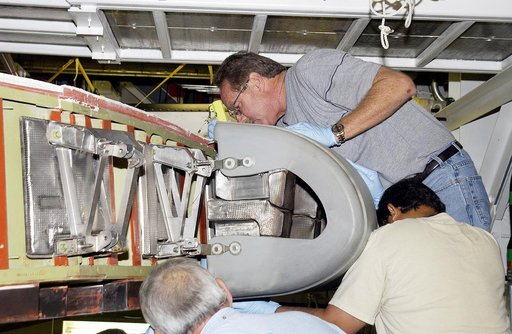 KENNEDY SPACE CENTER, FLA. - In the Orbiter Processing Facility, United Space Alliance workers Mike Hyatt (above), Saul Ngy (right) and Jerry Belt (below) install a Reinforced Carbon Carbon (RCC) panel to the leading edge of the wing of the orbiter Atlantis. The gray carbon composite RCC panels
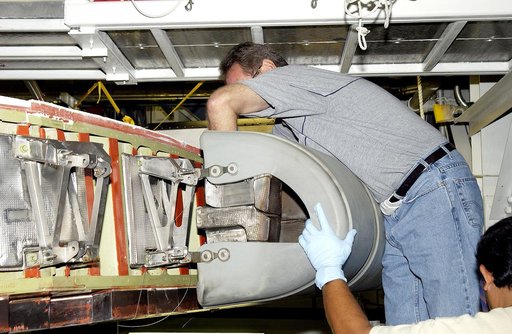 KENNEDY SPACE CENTER, FLA. - In the Orbiter Processing Facility, United Space Alliance workers Mike Hyatt (above) and Saul Ngy (below right) finish installing a Reinforced Carbon Carbon (RCC) panel to the leading edge of the wing of the orbiter Atlantis. The gray carbon composite RCC panels have su
 KENNEDY SPACE CENTER, FLA. - In the Orbiter Processing Facility, United Space Alliance worker Mike Hyatt (above) completes installation of a Reinforced Carbon Carbon (RCC) panel onto the leading edge of the wing of the orbiter Atlantis. The gray carbon composite RCC panels have sufficient strength
 2010-1088
 KSC-2012-1642