Public domain
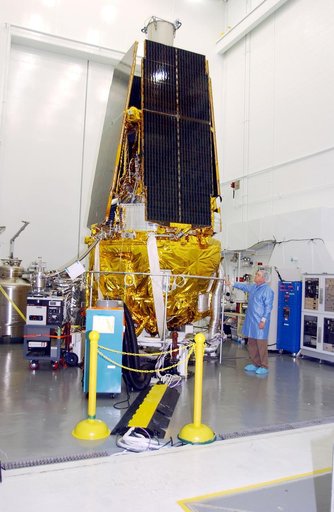
VANDENBERG AFB, CALIF. - In the NASA spacecraft processing facility on North Vandenberg Air Force Base, the Gravity Probe B spacecraft is seen with all four solar array panels installed. Installing each array is a 3-day process and includes a functional deployment test. The Gravity Probe B missio
From the collection of NASA Image and Video Library. Free to download, adapt and use — no permission needed.
About this work
Vandenberg Afb, Calif. — In the NASA spacecraft processing facility on North Vandenberg Air Force Base, the Gravity Probe B spacecraft is seen with all four solar array panels installed. Installing each array is a 3-day process and includes a functional deployment test. The Gravity Probe B mission is a relativity experiment developed by NASA’s Marshall Space Flight Center, Stanford University and Lockheed Martin.
NASA Image and Video Library’s own descriptionCredit lineVANDENBERG AFB, CALIF. - In the NASA spacecraft processing facility on North Vandenberg Air Force Base, the Gravity Probe B spacecraft is seen with all four solar array panels installed. Installing each array is a 3-day process and includes a functional deployment test. The Gravity Probe B mission is a relativity experiment developed by NASA’s Marshall Space Flight Center, Stanford University and Lockheed Martin. The spacecraft will test two extraordinary predictions of Albert Einstein’s general theory of relativity that he advanced in 1916: the geodetic effect (how space and time are warped by the presence of the Earth) and frame dragging (how Earth’s rotation drags space and time around with it). Gravity Probe B consists of four sophisticated gyroscopes that will provide an almost perfect space-time reference system. The mission will look in a precision manner for tiny changes in the direction of spin.. NASA/KSC, 2003-11-04. Public domain. ID: KSC-03pd3281.
Similar works
 KSC-04pd0785
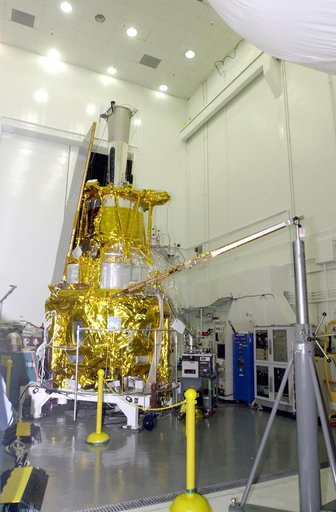 VANDENBERG AFB, CALIF. - In the NASA spacecraft processing facility on North Vandenberg Air Force Base, the Gravity Probe B spacecraft is seen with two solar array panels installed. Installing each array is a 3-day process and includes a functional deployment test. The Gravity Probe B mission is
 KSC-05pd-0074
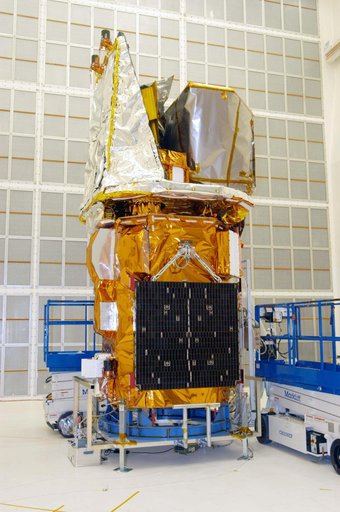 KSC-04pd2104
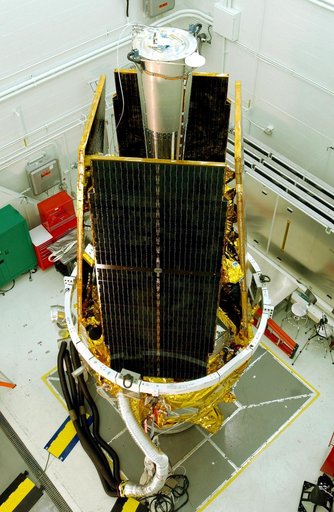 KSC-04pd0781
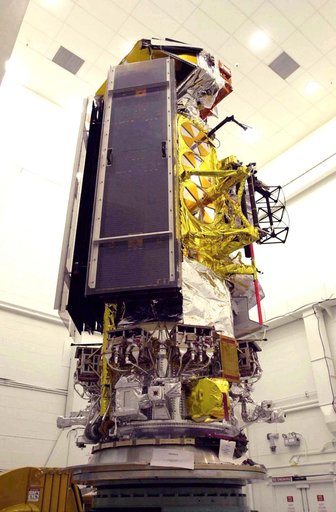 KSC-05pd-0668