Public domain
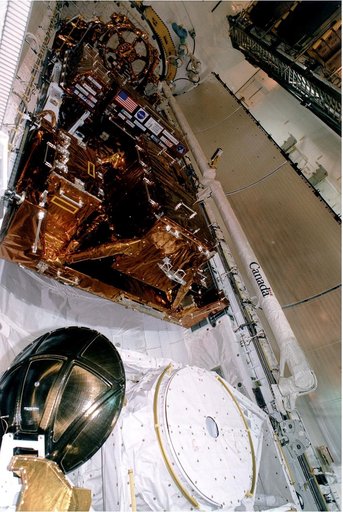
KENNEDY SPACE CENTER, FLA. - The Payload is seen inside of the Bay just before the doors are closed for flight at KSC's Launch Pad 39A. Discovery, the orbiter for the STS-82 mission, is ready for the launch of the second Hubble Space Telescope service mission. The payload consists of the Near In
From the collection of NASA Image and Video Library. Free to download, adapt and use — no permission needed.
About this work
Kennedy Space Center, Fla. — The Payload is seen inside of the Bay just before the doors are closed for flight at KSC's Launch Pad 39A. Discovery, the orbiter for the STS-82 mission, is ready for the launch of the second Hubble Space Telescope service mission. The payload consists of the Near Infrared Camera and Multi-Object Spectrometer (NICMOS) that will be installed, Fine Guidance Sensor #1 (FGS-1), and the Space Telescope Imaging Spectrograph (STIS) to be installed.
NASA Image and Video Library’s own descriptionCredit lineKENNEDY SPACE CENTER, FLA. - The Payload is seen inside of the Bay just before the doors are closed for flight at KSC's Launch Pad 39A. Discovery, the orbiter for the STS-82 mission, is ready for the launch of the second Hubble Space Telescope service mission. The payload consists of the Near Infrared Camera and Multi-Object Spectrometer (NICMOS) that will be installed, Fine Guidance Sensor #1 (FGS-1), and the Space Telescope Imaging Spectrograph (STIS) to be installed. The STS-82 will launch with a crew of seven at 3:54 a.m. EST, Feb. 11, 1997. The launch window is 65 minutes in duration. The Mission Commander for STS-82 is Ken Bowersox. The purpose of the mission is to upgrade the scientific capabilities, service or replace aging components on the Telescope, and provide a reboost to the optimum altitude.. NASA/KSC, 1997-02-07. Public domain. ID: KSC-97pc265.
Similar works
 KSC-08pd1789
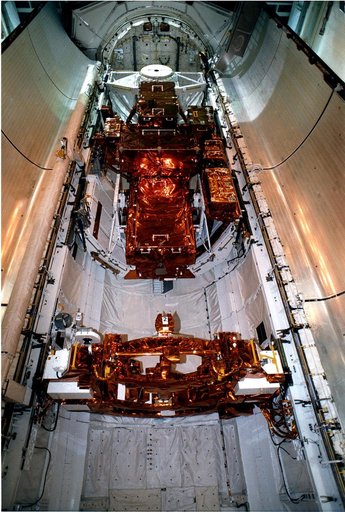 KENNEDY SPACE CENTER, FLA. - The Payload is seen inside of the Bay just before the doors are closed for flight at Pad 39A, Kennedy Space Center, Fla. Discovery, the orbiter for STS-82 mission, is ready for the launch of the second Hubble Space Telescope service mission. The payload consists of t
 KSC-02pd0167
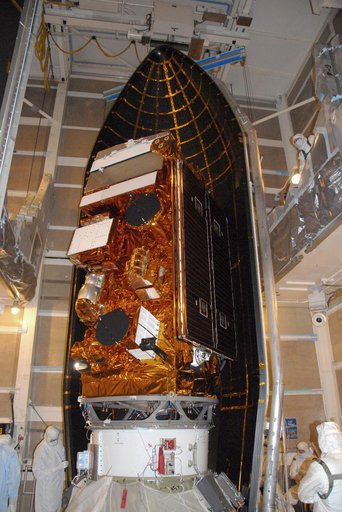 KSC-2011-7517
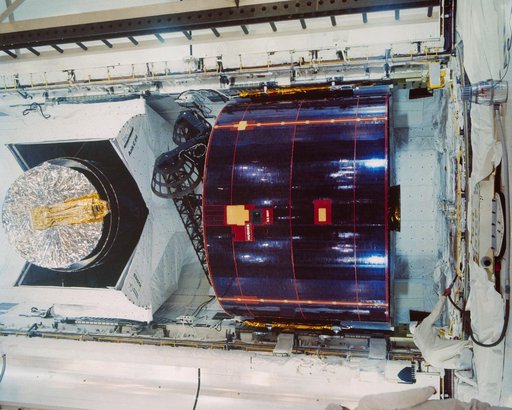 PREFLIGHT - STS-51D - KSC
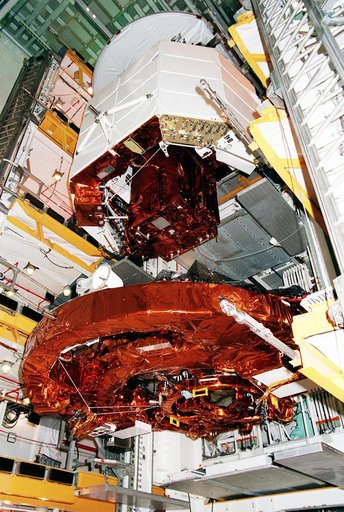 KSC-99pp1320