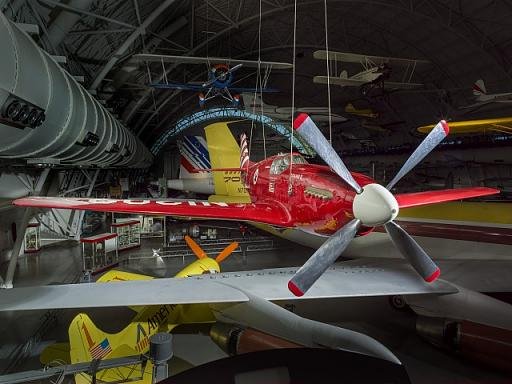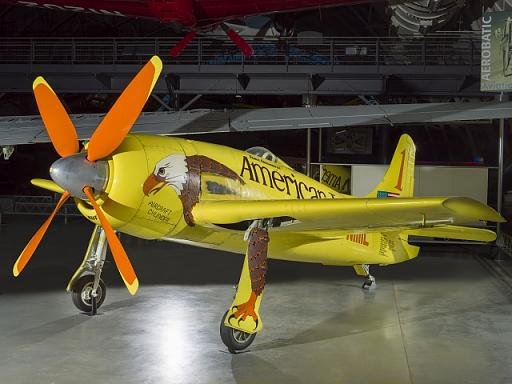
Grumman F8F-2, Bearcat, "Conquest I"
From the collection of National Air and Space Museum. Free to download, adapt and use — no permission needed.
The speed and competition of air racing drew test pilot Darryl G. Greenamyer to the National Championship Air Races, held every September near Reno, Nevada, beginning in 1964. World War II fighters were some of the most powerful propeller-driven, piston-engine aircraft ever made, so they were ideal for the Unlimited Class, which dictated no restrictions to limit performance. Greenamyer and a team of fellow Lockheed Skunk Works employees used their engineering creativity to modify a Grumman F8F-2 Bearcat into a purpose-built air racer. Grumman designed the Bearcat late in World War II as a replacement for the F6F Hellcat Navy fighter. It was noted for its exceptional climbing ability and maneuverability. Conquest 1 featured a shorter wingspan than the production Bearcat, a special small bubble canopy, a larger propeller taken from a Douglas A-1 Skyraider, and a propeller spinner from a North American P-51H Mustang. Special high-octane gasoline, fuel additives, and putty-sealed gaps to reduce drag greatly increased its speed.
National Air and Space Museum’s own description