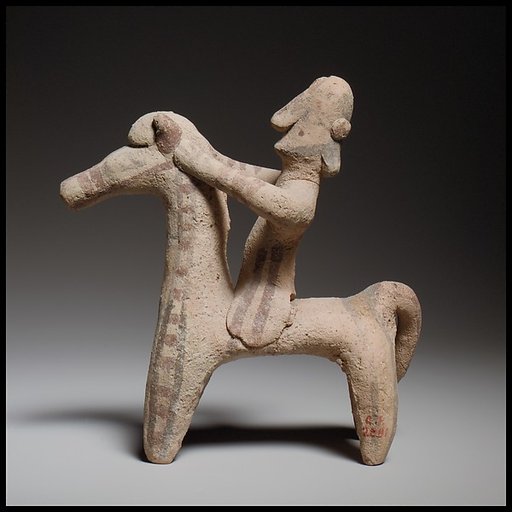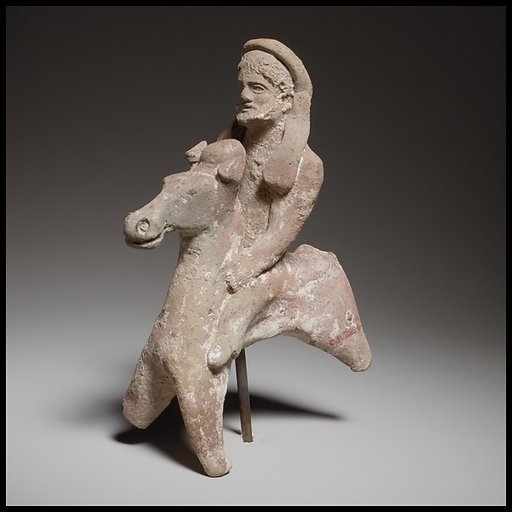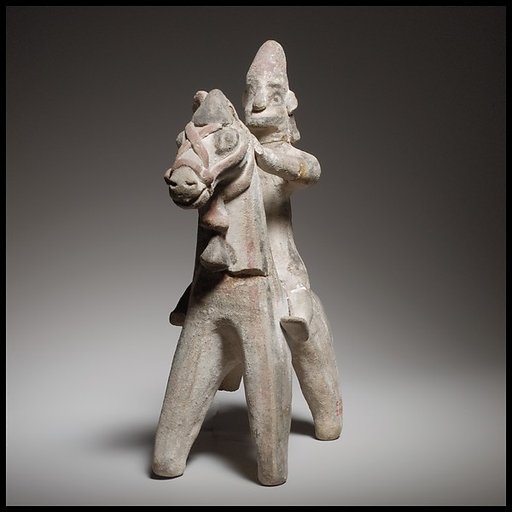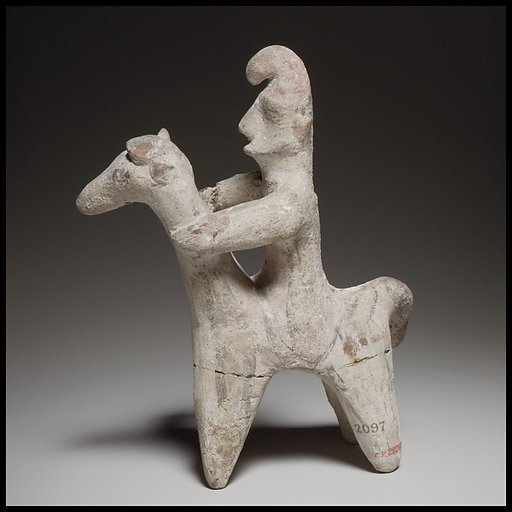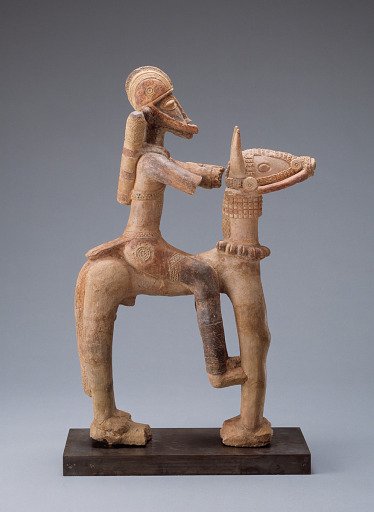
Equestrian figure
From the collection of National Museum of African Art. Free to download, adapt and use — no permission needed.
Since the 1940s, low-fired ceramic figures and fragments such as this have been unearthed at various sites throughout the Inland Niger Delta region, an area that once had highly developed urban centers. These works are among the earliest known surviving art forms in sub-Saharan Africa. The makers were from the various peoples in the region, but it is not known whether they were men or women. Using a mixture of coarse clay and added grog (crushed pot sherds), the potters modeled the figures by hand. Some were modeled in separate parts and fitted together. Most surviving examples are solid, but a few are hollow and built with clay coils. The surfaces are polished and covered with a red slip (clay wash). These massive works are among the largest known terracotta figures created by sub-Saharan African potters. By the 15th or 16th century, environmental and political events caused the urban centers of the Delta region to be abandoned, and the art tradition did not survive.
National Museum of African Art’s own description