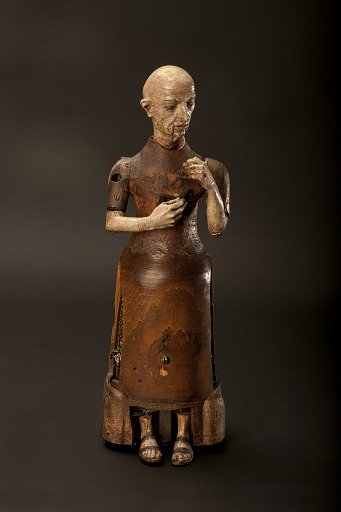
Automaton of a Friar
From the collection of National Museum of American History. Free to download, adapt and use — no permission needed.
This is an automaton made in the 16th century in the figure of a friar. The figure has a key-wound iron clockwork encased in an unpainted wooden body. The clockwork has a spring in the drum and fusee with cord. It has a wooden head with moveable eyes and lower jaw. The limbs and head are connected to the clockwork with chains and the lower joint of the left arm is connected with a cord. A band of fabric, 2" wide, is fastened with adhesive to the bottom of the body. Traces of flesh-colored enamel can be found on its bald head, hands and feet; red on the lips, brown on the eyes, eyebrows and sandals. The enamel is badly cracked and chipped away in many places. Fully operational, the figure walks in a trapezoidal pattern; moves both arms (right arm strikes chest in "mea culpa" and left arm raises rosary to lips); moves eyes side to side; opens and closes mouth; and turns head.
National Museum of American History’s own description