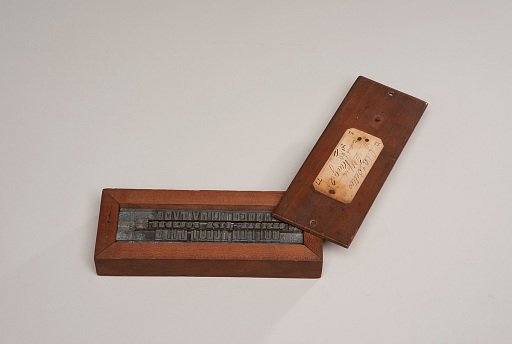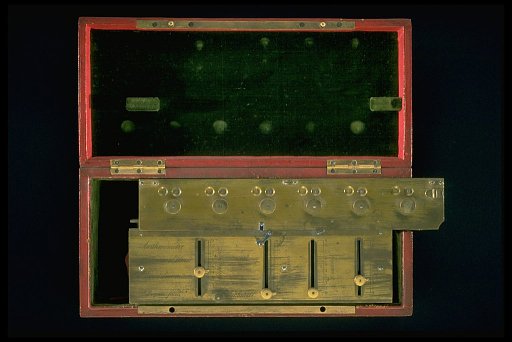
Mathematical Table, Young Rule For Calculating Interest
From the collection of National Museum of American History. Free to download, adapt and use — no permission needed.
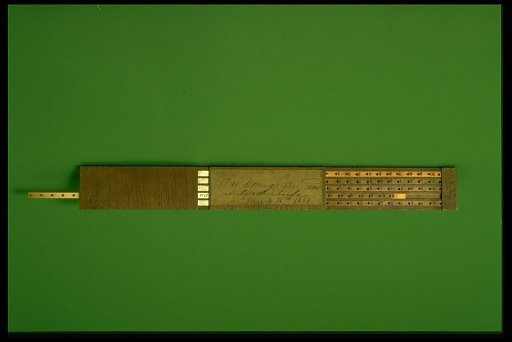
This United States patent model has a rectangular wooden frame with five grooves, each of which holds a bar (made from a different kind of wood) that slides crosswise. Two flat wooden pieces cover much of the bars on the left side, with a gap between them. Each bar has a set of twelve evenly spaced holes that are numbered from 11 down to 1 (the “0” holes are not numbered). Each bar also is indented at the top to hold a slip of paper that slides under the top of the machine. There are eleven further, unnumbered, holes to the right of each slip of paper. Setting up a number on the rods (to represent an amount of money or a length of time) reveals a number on the paper slips that represents an amount of tax or interest.
National Museum of American History’s own description