Strode Adding Machine for Accounting
From the collection of National Museum of American History. Free to download, adapt and use — no permission needed.
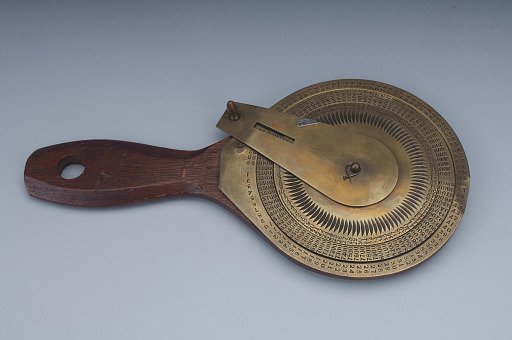
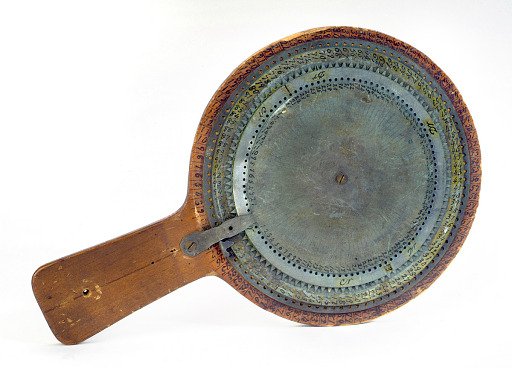
The base of this U.S. Patent Office model for a circular stylus-operated adding machine is a wooden paddle. The outer edge of the paddle is divided clockwise into 100 parts, which are marked in ink. Five concentric metal discs are atop the paddle, each one slightly smaller than the one below. The discs are held together at the middle by a screw. The first disc above the paddle has 100 holes around the edge and rotates. The second disc is fixed, with the numbers from 1 to 97 marked in pen counterclockwise around the edge (a few higher digits are hidden). The third disc is toothed, and has the numbers from 1 to 100 around its edge, inside the teeth. The fourth disc covers the third one, with one notch that reveals a number on the toothed disc. The fourth disc also has 100 holes around its edge. Just inside these holes is the fifth, top disc. It also is divided into 100 parts around the edge. These are marked in pen from 1 to 50 going counterclockwise on the right side, and from 1 to 47 going clockwise around the left side (a few divisions are unmarked). The first disc is intended to represent sums of numbers up to 100 (cents), and to carry a term to advance the third disc, which represents hundreds (dollars). The smallest disc can be used as a guide in adding or subtracting hundreds.
National Museum of American History’s own description