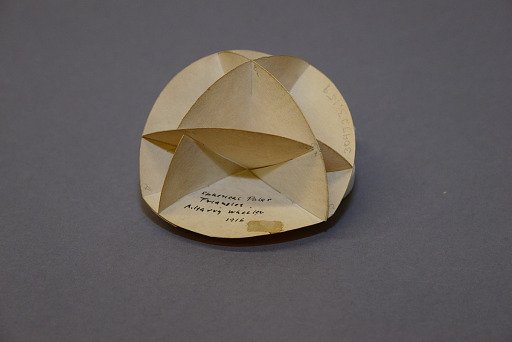
Geometric Model by A. Harry Wheeler, Spherical Polar Triangles
From the collection of National Museum of American History. Free to download, adapt and use — no permission needed.
This cut and folded tan paper model is one of several in which A. Harry Wheeler illustrated properties of polar spherical triangles. A line perpendicular to the plane of a great circle of a sphere intersects the sphere in two points called poles (for example, on the earth, the great circle of the equator has poles the North Pole and South Pole). In the model, the outer spherical triangle has vertices labeled A, B, and C. Vertices of the inner spherical triangle are A<sub>2</sub>, B<sub>2</sub>, and C<sub>2</sub>. A is the pole nearest A<sub>2</sub> of the great circle of the sphere that includes the arc B<sub>2</sub> C<sub>2</sub>. B is the pole nearest B<sub>2</sub> of the great circle that includes the arc A<sub>2</sub>C<sub>2</sub>. C is the pole nearest C<sub>2</sub> of the great circle that includes arc A<sub>2</sub>B<sub>2</sub>. Also, spherical triangle A<sub>2</sub>B<sub>2</sub>C<sub>2</sub> is the polar triangle of spherical triangle ABC (A<sub>2</sub> is the pole nearest A of a great circle through BC and so forth).
National Museum of American History’s own descriptionSimilar works
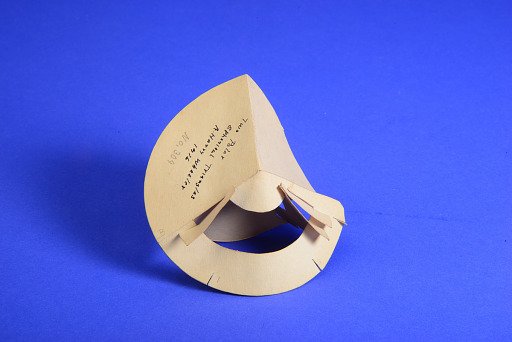 Geometric Model by A. Harry Wheeler, Two Polar Spherical Triangles
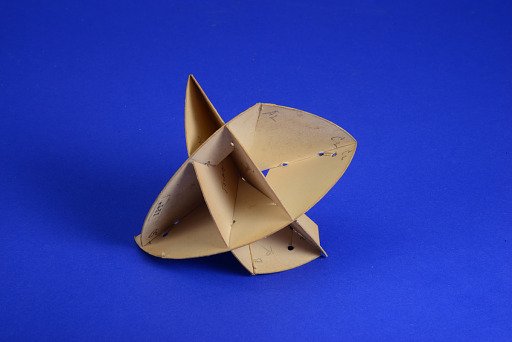 Geometric Model by A. Harry Wheeler, Intersecting Polar Triangles
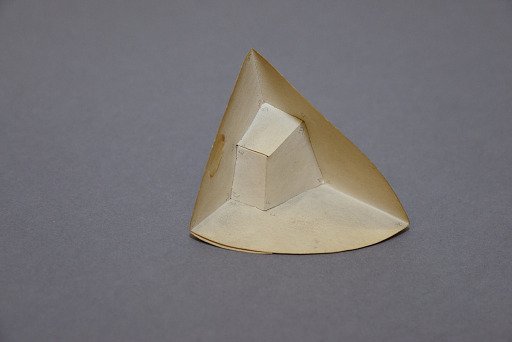 Geometric Model by A. Harry Wheeler, Supplementary Trihedral Angles
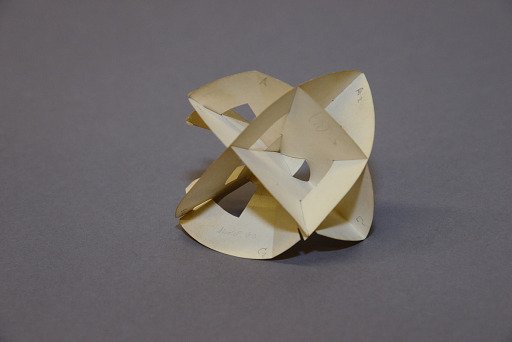 Geometric Model by A. Harry Wheeler, Intersecting Polar Spherical Triangles
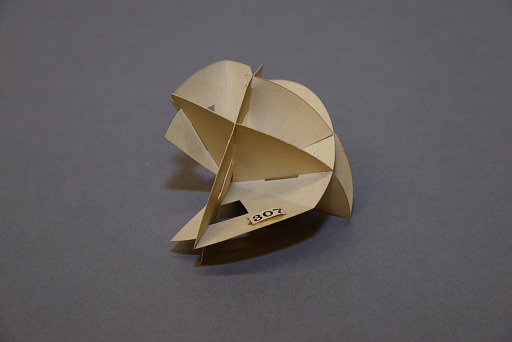 Geometric Model by A. Harry Wheeler, Two Collapsible Intersecting Spherical Polar Triangles
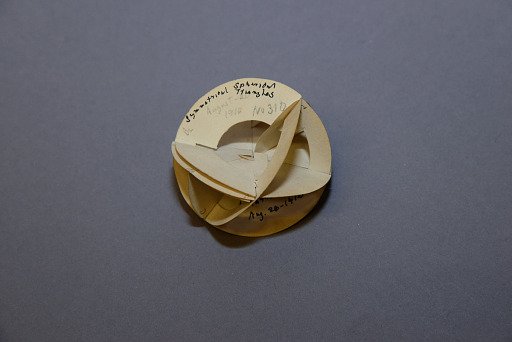 Geometric Model by A. Harry Wheeler, Symmetrical Spherical Triangles