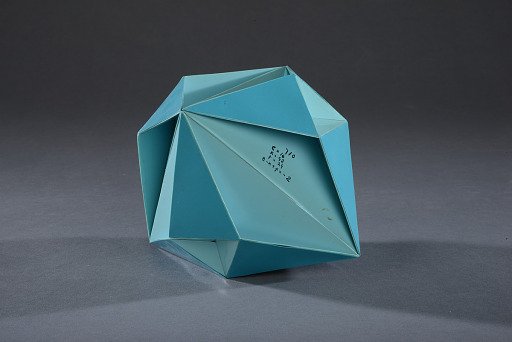
Geometric Model by A. Harry Wheeler, One-Sided Polyhedron
From the collection of National Museum of American History. Free to download, adapt and use — no permission needed.
This self-intersecting polyhedron has twelve trapezoidal faces (made out of light turquoise plastic) and twelve triangular faces (made out of dark turquoise plastic). It has twelve vertices at which two trapezoids and two triangles meet and four vertices at which six trapezoids and three triangles meet. The polyhedron has a total of 42 edges. A mark on one face of the polyhedron reads: 710 (/) e = 16 (/) k = 42 (/) f = 24 (/) e – k + f = -2. The number 710 is that Wheeler assigned to the model. The other marks refer to the Euler characteristic of the polyhedron, which equals the number of vertices, minus the number of edges, plus the number of faces. Hence: 16 – 42 + 24 = -2.
National Museum of American History’s own descriptionSimilar works
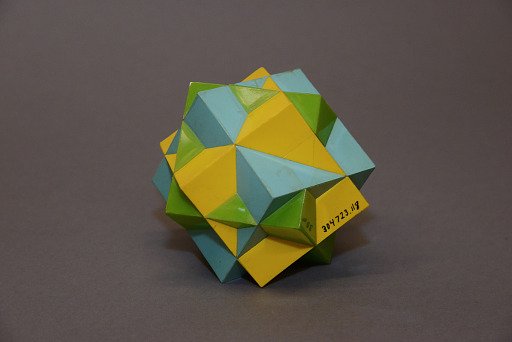 Geometric Model by A. Harry Wheeler, Union of Three Cubes
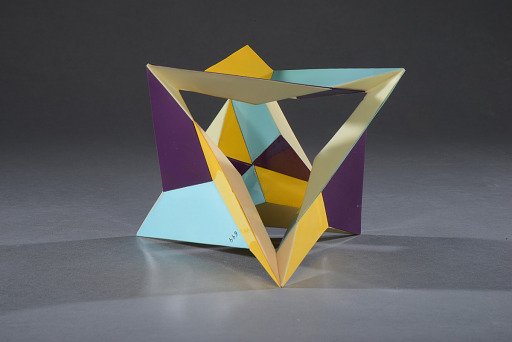 Geometric Model by A. Harry Wheeler, One-Sided Polyhedron
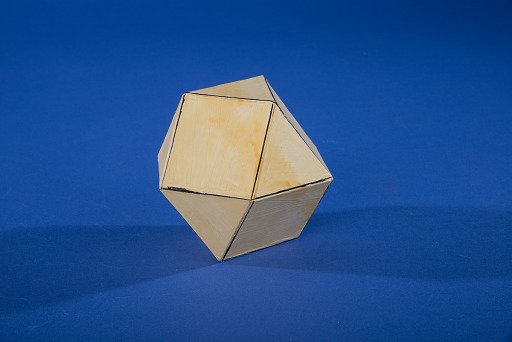 Polyhedron Model by Martin Berman, Cuboctahedron
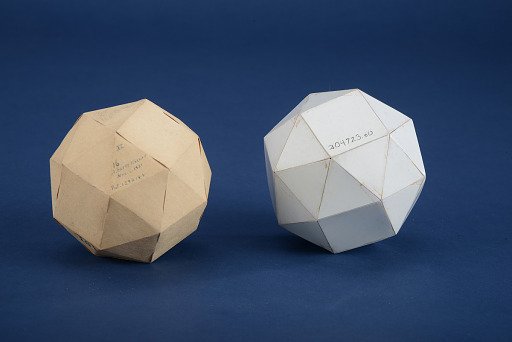 Geometric Model by A.Harry Wheeler, Snub Cube
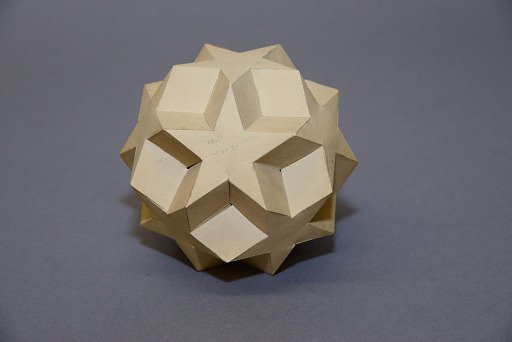 Geometric Model by Dick Holl, a Student of A.Harry Wheeler, Dodecadodecahedron
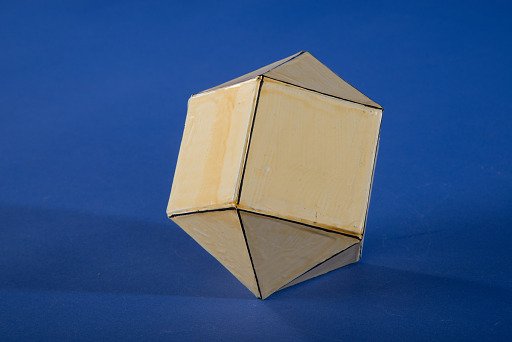 Polyhedron Model by Martin Berman, Elongated Pentagonal Dipyramid