Carroll Adding Machine
From the collection of National Museum of American History. Free to download, adapt and use — no permission needed.
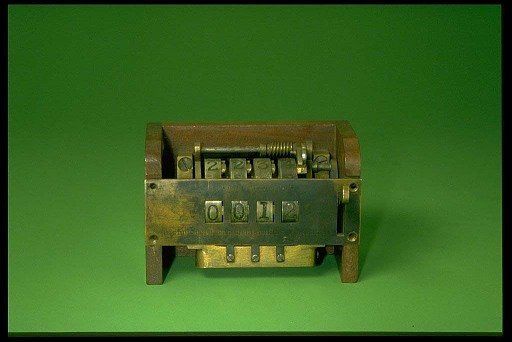
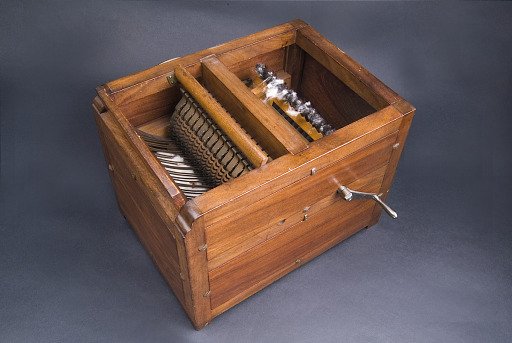
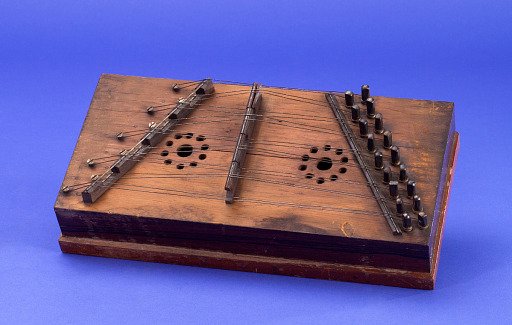
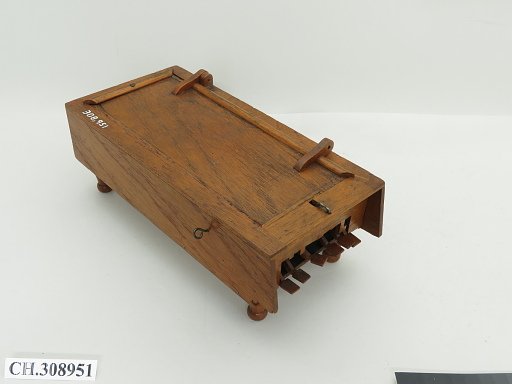
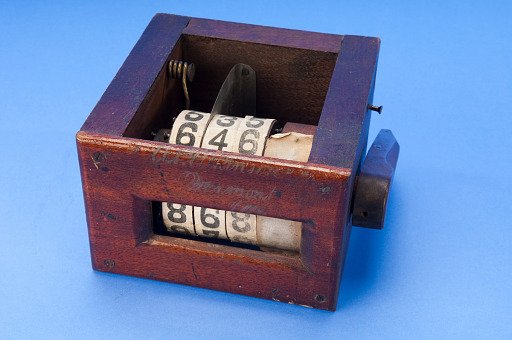
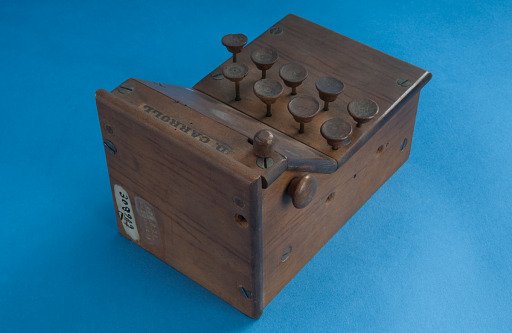
This is the U.S. Patent Office model for a nine-key non-printing adding machine. The small machine has a wooden case with nine metal keys with wooden key covers, arranged in two rows. There are three wooden numeral wheels visible through a window at the back top. The machine apparently is designed to add single digits up to 999. No numbers are visible on the key tops. The keys in each row presently appear to operate [no effect] 4 6 8 (/) [no effect] 2 3 5 7. The patent drawing indicates that the keys are arranged 2 4 6 8 (/) 4 5 5 7 9. The effect of the keys is determined by adjusting screws on the underside of the machine. The four registering wheels to the left have on their left side a ring of ten equidistant pins that are used in carrying. There is a lever at the top of the machine that can be adjusted to release the number wheels so that they can be turned back to zero using a button on the left. The device was patented by David Carroll of Spring Creek, Pennsylvania. Carroll took out other U.S. patents for ship’s logs (197995, granted in 1877; also 303115, granted in 1884), and a stump extractor (64628, granted in 1867, reissued in 1879).
National Museum of American History’s own description