Persian Planispheric Astrolabe
From the collection of National Museum of American History. Free to download, adapt and use — no permission needed.
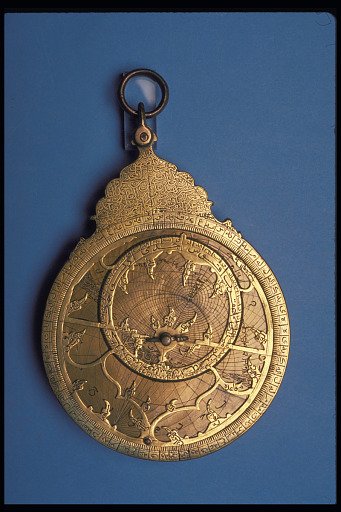
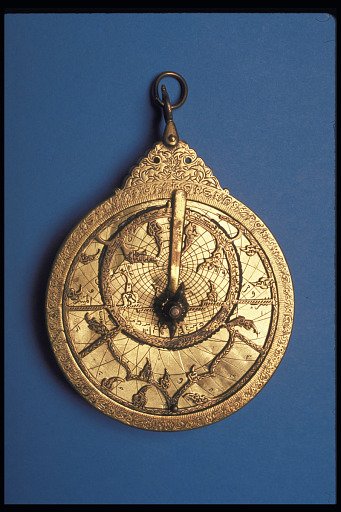
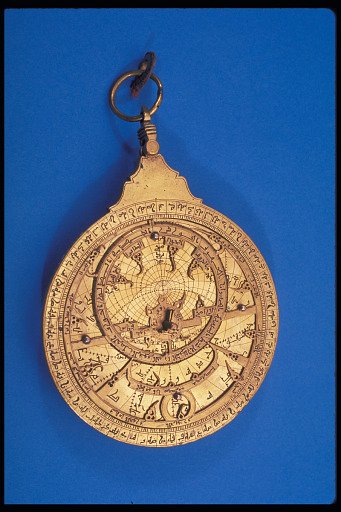
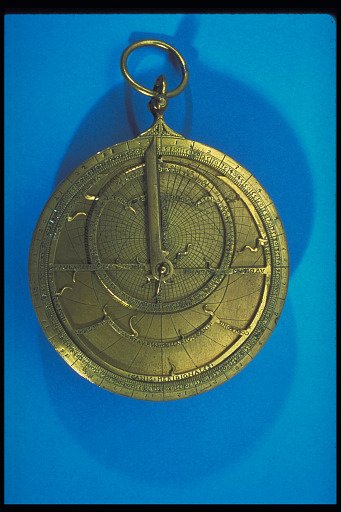
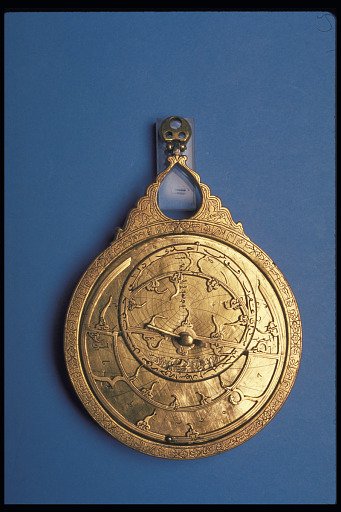
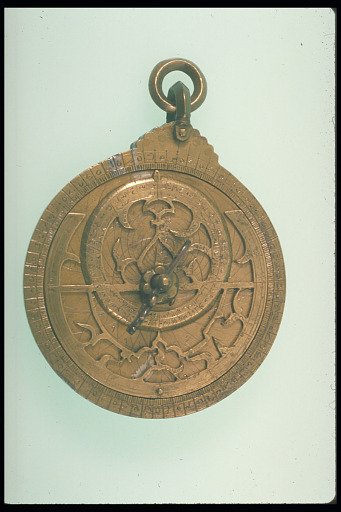
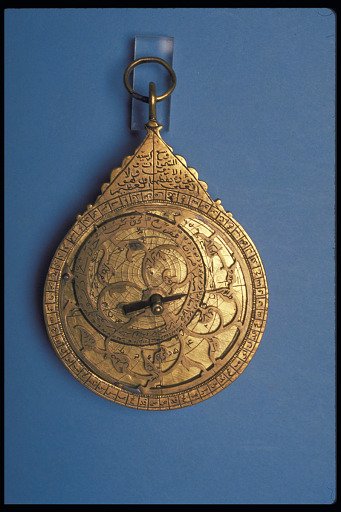
The astrolabe is an astronomical calculating device used from ancient times into the nineteenth century. Measuring the height of a star using the alidade on the back of the instrument, and knowing the latitude, one could find the time of night and the position of other stars. The openwork piece on the front, called the rete, is a star map of the northern sky. Pointers on the rete correspond to stars; the outermost circle is the Tropic of Capricorn, and the circle that is off-center represents the zodiac, the apparent annual motion of the sun. Engraved plates that fit below the rete have scales of altitude and azimuth (arc of the horizon) for specific latitudes. This brass Persian astrolabe has a body with throne, handle, ring, an alidade with pin, a rete, five plates, and a wedge at the front that holds the instrument together. The instrument is unsigned.
National Museum of American History’s own description