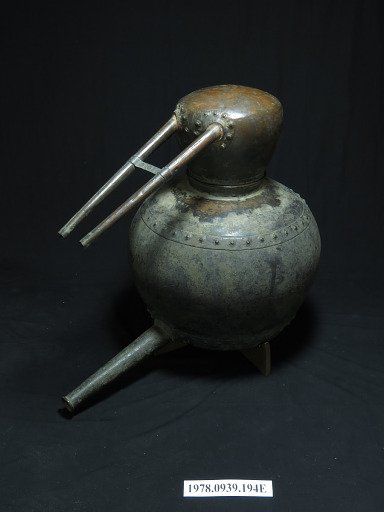
Sturtevant’s Patent Model of a Heating and Ventilating Apparatus – ca 1870
From the collection of National Museum of American History. Free to download, adapt and use — no permission needed.
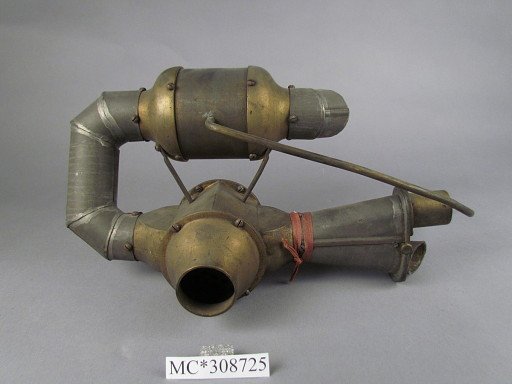
This model was filed with the application to the U.S. Patent Office for Patent Number 100,211 issued to B. F. Sturtevant of Jamaica Plains, MA on February 22, 1870. The patent described a forced air heating system consisting of a steam producing boiler, a steam engine to drive a centrifugal wheel fan for circulating air, a heat exchanger to heat the air via the combustion products of the boiler, a condenser utilizing the circulating air to return the steam to water for reuse, and a series of duct work and valves. The patent model illustrates only the central duct work, heat exchanger and steam condenser. Diagrams showing the complete heating and ventilating apparatus design can be found in the patent document online (www.USPTO.gov/patents/process/search/index.jsp). In the image the upper cylinder is the steam condenser. The cylinder at the bottom represents the heat exchanger. The opening at its front is where the combustion gases from the boiler would exit via a flue or chimney. Cold air entered at the ducts at the lower right. Two separate intakes are shown – the bottom was for fresh air from outside the building and the upper for recirculated air from heated rooms. A valve allowed engineers to regulate the ratio of outside to inside air. Hot air exited at the right side of the condenser via the ductwork which was connected to the engine-driven fan’s inlet. The heated, pressurized air exited from the fan into a series of ducts that would supply heat to various parts of the building. The patent also made provisions for domestic water heating by utilizing some of the condenser’s hot water for that purpose. Sturtevant claimed his design increased efficiency by making use of hot flue gases as the primary source to heat air but also by using the remaining energy of the steam in the condenser to further heat the air. Sturtevant was extremely successful with this and his other patents (no less than 10 patents dealing with heating and ventilation were granted to him on the same day as this patent). In 1860 he founded the B. F. Sturtevant Co. which was extremely successful and long lived; Westinghouse bought the company in 1945, and operations continued at the Hyde Park, MA factory until its closing in 1989. The company’s equipment was installed in many public and private buildings including the U.S. Capitol and the “New National Museum, Washington, D.C” – now the Smithsonian National Museum of Natural History.
National Museum of American History’s own description