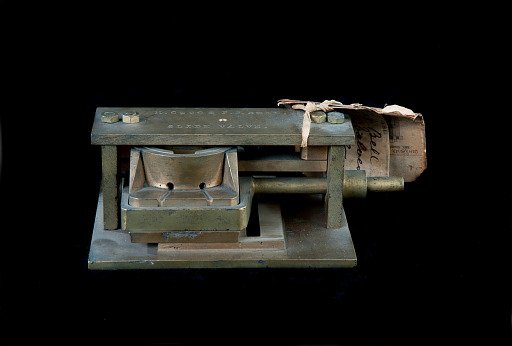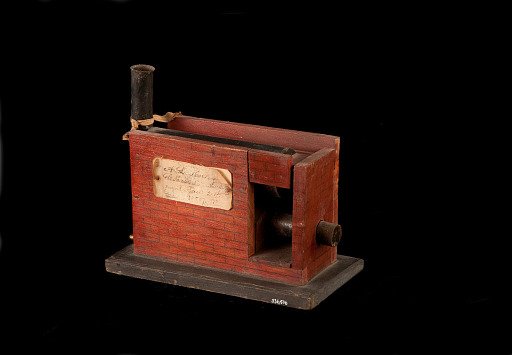
Holley’s Patent Model of a Steam-Boiler Furnace – 1880
From the collection of National Museum of American History. Free to download, adapt and use — no permission needed.
This model was filed with the application to the U.S. Patent Office for Patent Number 238,235 issued to Alexander Lyman Holley of Brooklyn, NY on March 1, 1881. Holley’s patent was for an improved gas-fueled steam-boiler for use in a furnace. Mr. Holley noted that past objections to the use of gas for fuel dealt with poor combustion of the gas due to incomplete mixing with combustion air. His invention related to a new way to mix the air and gas more completely prior to introduction into the combustion chamber. He provided for separate entry flues for the gas and air. These ran beneath the floor of the combustion chamber. Slots were cut into the floor perpendicular to the flues. Alternate slots were connected to either the gas flue or air flue. In his patent application drawing, he showed five slots – two for gas and three for air. He conceived that the pressure feeding the air and gas would create jets through the slots into the combustion chamber where mixture would occur and combustion take place. To facilitate this, he included a curved diaphragm as the top of the combustion chamber. The combustion gases would then be carried upwards through tubes in the boiler and thence to the exhaust. Research of available trade literature and other sources has not revealed any commercial product that may have made use of Mr. Holley’s invention. Mr. Holley was an engineer of great reputation in the steel making industry and was a founding member of the American Society of Mechanical Engineers.
National Museum of American History’s own description