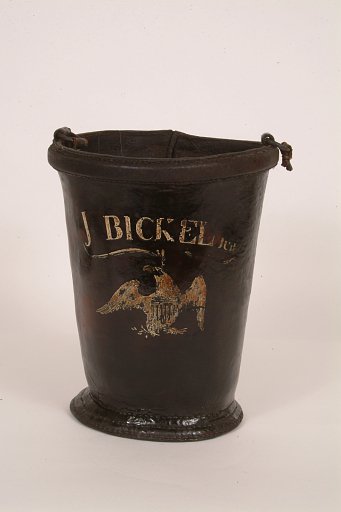
Fire Bucket, "J. Bickel."
From the collection of National Museum of American History. Free to download, adapt and use — no permission needed.
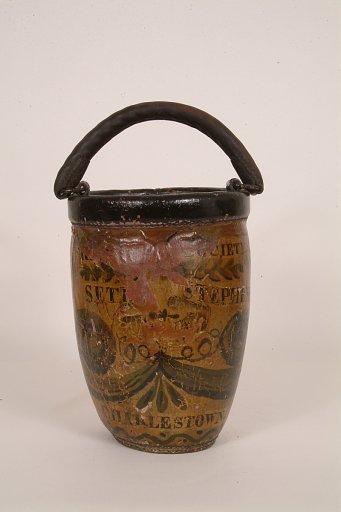
On this bucket, the eagle of the Great Seal of the United States was painted below the name of the owner, J. Bickel. The design for the Great Seal was adopted on June 20, 1782, after several years of discussion and modification. On the Seal, the eagle is posed with wings and legs fully extended, which in heraldry is known as the “displayed” position. In the right talon, the eagle holds an olive branch, representing peace. In the left talon is a bundle of arrows, symbolizing war or the willingness to defend peaceful ideals. On the bird’s breast is a shield with thirteen red and white stripes and thirteen stars. In its beak, the eagle holds a ribbon with the motto E Pluribus Unum (“Out of Many, One”), and above the eagle’s head is a constellation of thirteen stars. After its adoption as the symbol on the Great Seal, the eagle became a popular patriotic symbol, used in a profusion of forms. A symbol of strength, the eagle was carved, embroidered, painted, and drawn on everything imaginable. The eagle was a symbol commonly used by volunteer firefighters to demonstrate their virility and patriotism. On this bucket, the design of the Great Seal features a common modification: the shield features only stripes, and the ribbon and stars are missing.
National Museum of American History’s own description