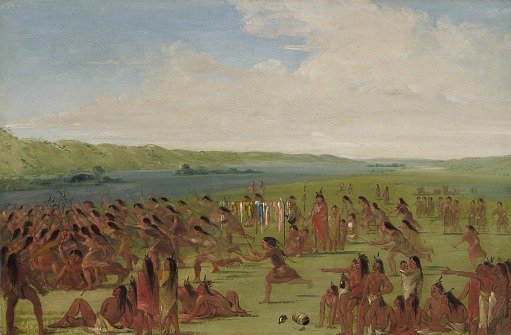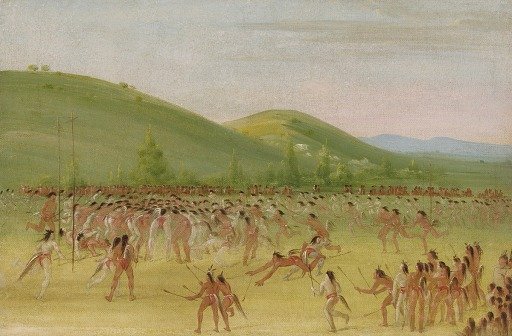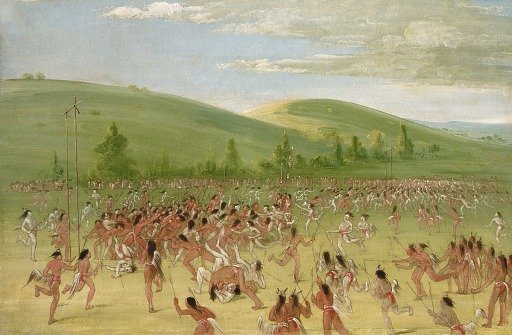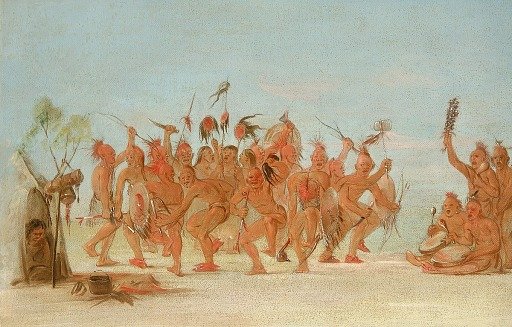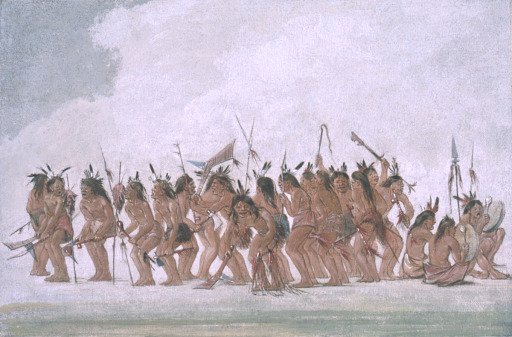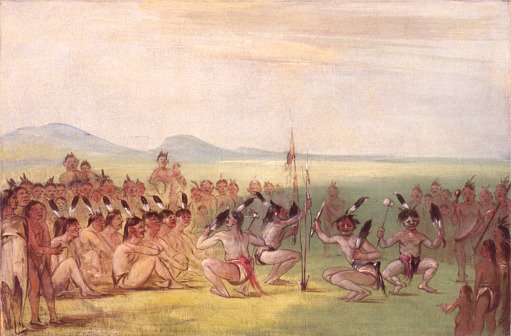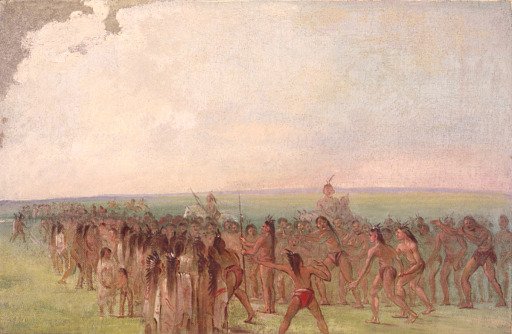
Footrace behind the Mandan Village
From the collection of Smithsonian American Art Museum. Free to download, adapt and use — no permission needed.
“The Mandans (or See-pohs-kah-nu-mah-kah-kee, ‘people of the pheasants,’ as they call themselves), are perhaps one of the most ancient tribes of Indians in our country. Their origin, like that of all the other tribes is from necessity, involved in mystery and obscurity . . . This tribe is at present located on the west bank of the Missouri, about 1800 miles above St. Louis, and 200 below the Mouth of Yellow Stone river. They have two villages only, which are about two miles distant from each other; and number in all (as near as I can learn), about 2000 souls. Their present villages are beautifully located, and judiciously also, for defence against the assaults of their enemies.” George Catlin sketched this scene at a Mandan village in 1832. (Catlin, Letters and Notes, vol. 1, no. 11, 1841; reprint 1973)
Smithsonian American Art Museum’s own description