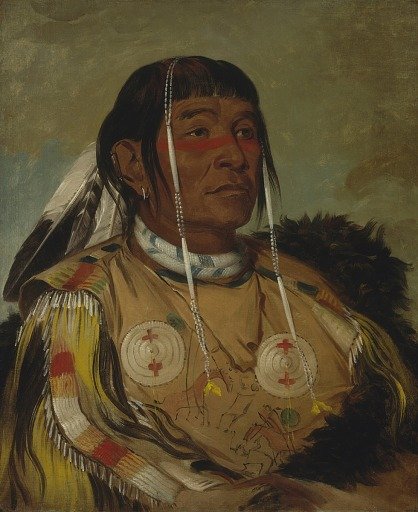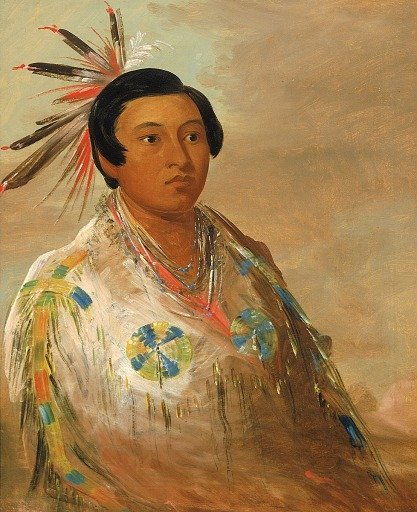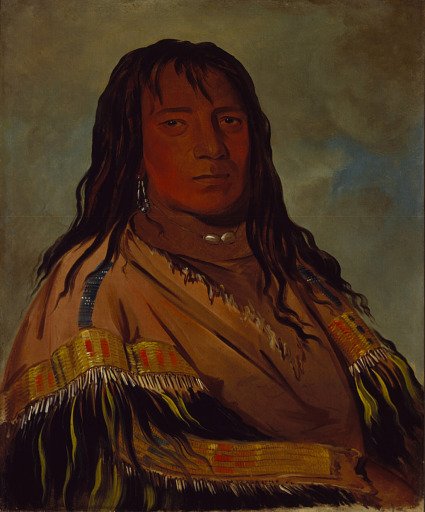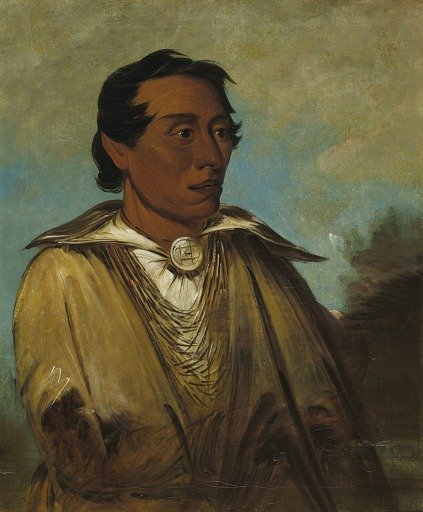
Kee-án-ne-kuk, Foremost Man, Chief of the Tribe
From the collection of Smithsonian American Art Museum. Free to download, adapt and use — no permission needed.
“The present chief of [the Kickapoos] . . . usually called the . . . Shawnee Prophet, is a very shrewd and talented man. When he sat for his portrait, he took his attitude as seen in the picture, which was that of prayer. And I soon learned that he was a very devoted Christian . . . It was told to me in the tribe by the Traders (though I am afraid to vouch for the whole truth of it), that while a Methodist preacher was soliciting him for permission to preach in his village, the Prophet refused him the privilege, but secretly took him aside and supported him until he learned from him his creed, and his system of teaching it to others.” George Catlin probably executed this work at Fort Leavenworth (in today’s Kansas) in 1830. (Catlin, Letters and Notes, vol. 2, no. 47, 1841; reprint 1973)
Smithsonian American Art Museum’s own description