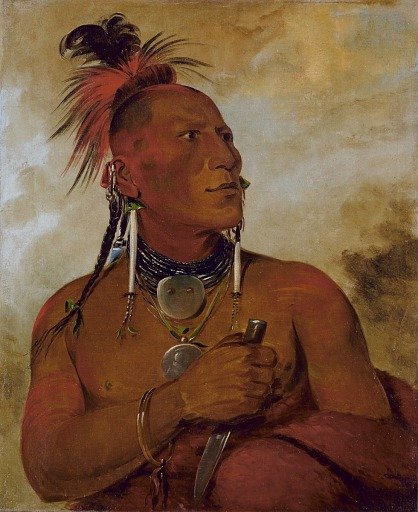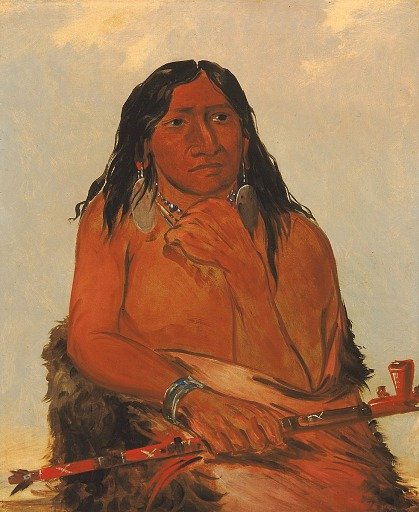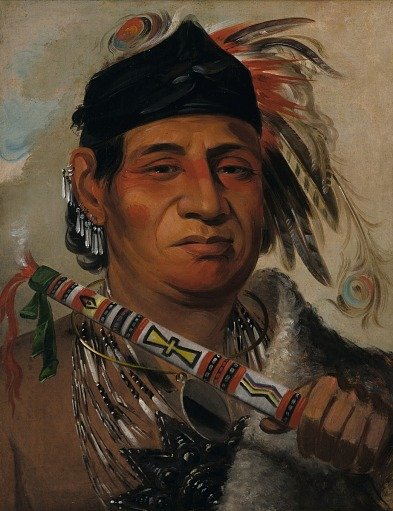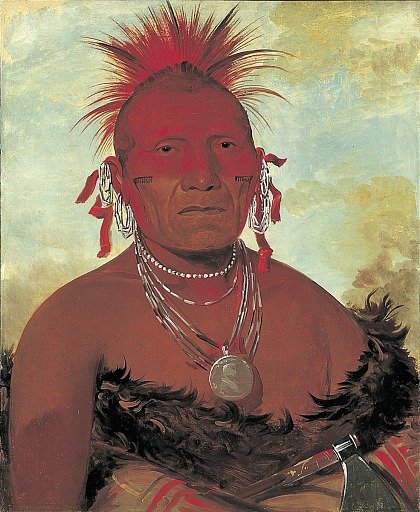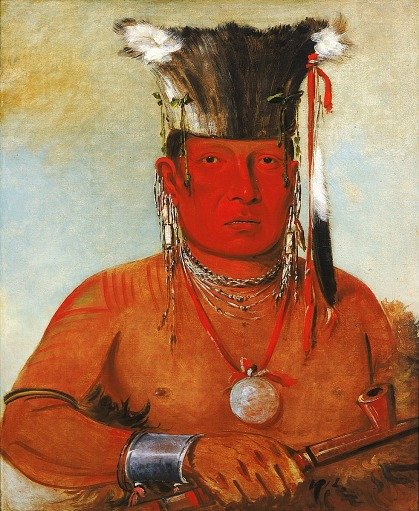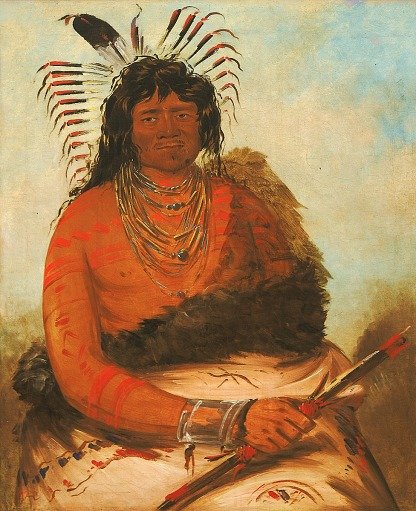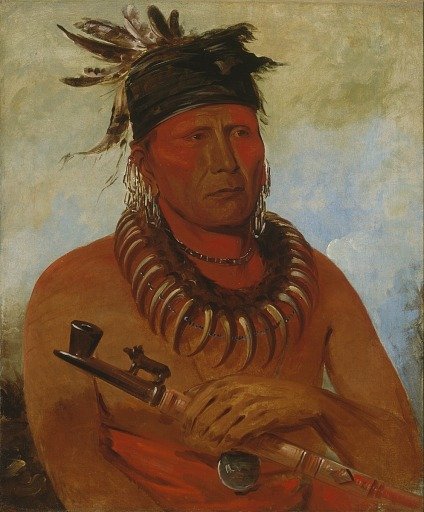
Háw-che-ke-súg-ga, He Who Kills the Osages, Chief of the Tribe
From the collection of Smithsonian American Art Museum. Free to download, adapt and use — no permission needed.
George Catlin described He Who Kills the Osages as “an old man” wearing a “necklace of grisly bears’ claws, and a handsome carved pipe in his hand.” The name of Kills the Osages is redolent of the history of his tribe as well as his own battle achievements. A century before Catlin’s arrival in the West, the Missouria controlled the fur trade on the river that bears their name; their dominance, however, was under constant assault from the Osages, who eventually won. By the time Catlin met this elderly war chief, the Missouria, much reduced in power and number, had joined with the Otoes. Catlin probably painted this image at Fort Leavenworth (in today’s Kansas) in 1832. (Catlin, 1848 Catalogue, Catlin’s Indian Gallery, SAAM online exhibition; Gurney and Heyman, eds., George Catlin and His Indian Gallery, 2002)
Smithsonian American Art Museum’s own description