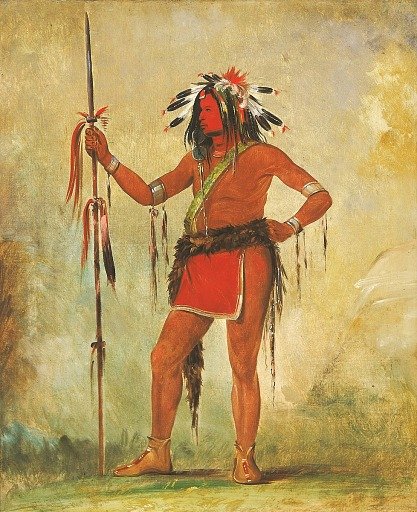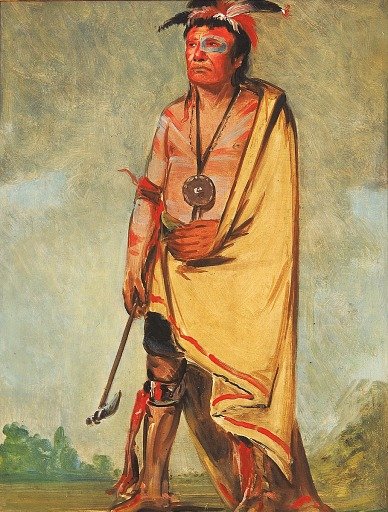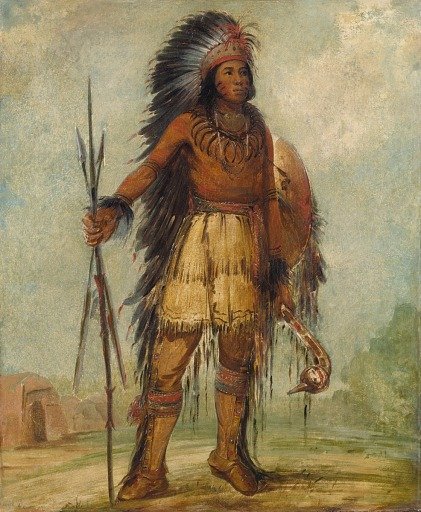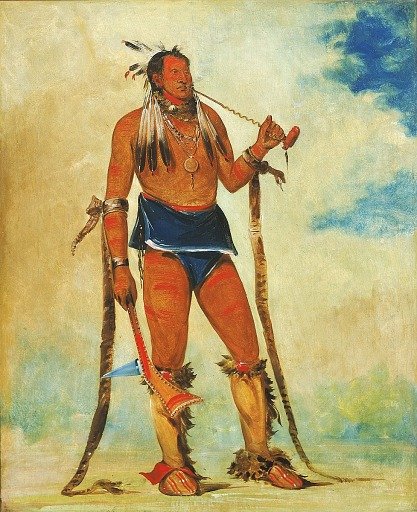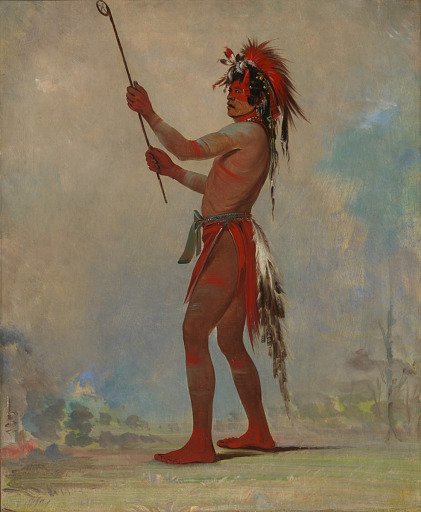
We-chúsh-ta-dóo-ta, Red Man, a Distinguished Ball Player
From the collection of Smithsonian American Art Museum. Free to download, adapt and use — no permission needed.
George Catlin painted two portraits of Sioux Indians with “ball-sticks” in hand while at Fort Snelling, near the juncture of the Mississippi and Minnesota rivers. He described his subjects as “the two most distinguished ball-players in the Sioux tribe” who came to his studio “in the dress in which they had just struggled in the play.” This full-length portrait captures Red Man’s athleticism and reflects his status as a tribal champion. Catlin worried about the fate that he feared lay in store for these men. He wrote that “My heart has sometimes almost bled with pity for them, while amongst them, and witnessing their happy sports.” The artist was constantly reminded of “the inevitable bane that was rapidly advancing upon them.” (Catlin, Letters and Notes, vol. 2, no. 50, 1841, reprint 1973; Gurney and Heyman, eds., George Catlin and His Indian Gallery, 2002)
Smithsonian American Art Museum’s own description