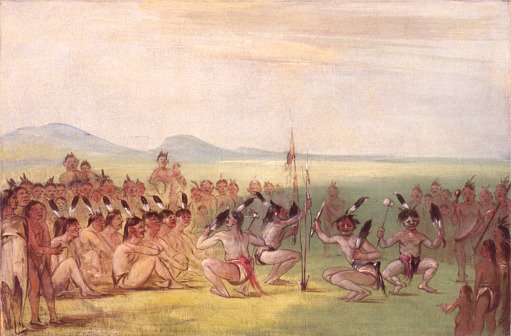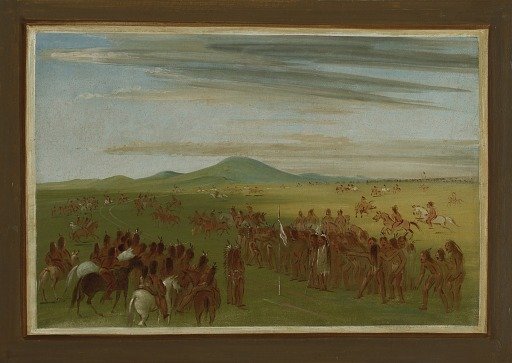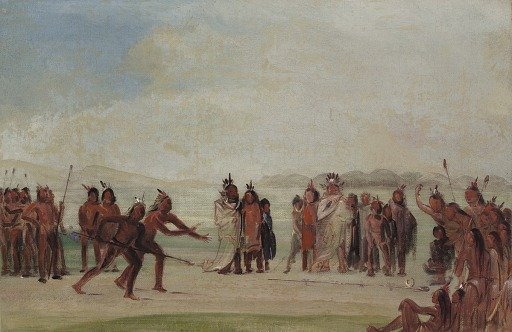
Tchung-kee, a Mandan Game Played with a Ring and Pole
From the collection of Smithsonian American Art Museum. Free to download, adapt and use — no permission needed.
“The game of Tchung-kee [is] a beautiful athletic exercise, which [the Mandan] seem to be almost unceasingly practicing whilst the weather is fair, and they have nothing else of moment to demand their attention. This game is decidedly their favourite amusement, and is played near to the village on a pavement of clay, which has been used for that purpose until it has become as smooth and hard as a floor . . . The play commences with two (one from each party), who start off upon a trot, abreast of each other, and one of them rolls in advance of them, on the pavement, a little ring of two or three inches in diameter, cut out of a stone; and each one follows it up with his ‘tchung-kee’ (a stick of six feet in length, with little bits of leather projecting from its sides of an inch or more in length), which he throws before him as he runs, sliding it along upon the ground after the ring, endeavouring to place it in such a position when it stops, that the ring may fall upon it, and receive one of the little projections of leather through it.” George Catlin made this sketch at a Mandan village in 1832. (Catlin, Letters and Notes, vol. 1, no. 19, 1841; reprint 1973)
Smithsonian American Art Museum’s own description