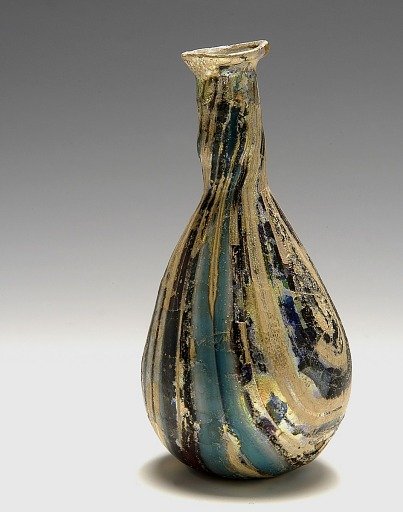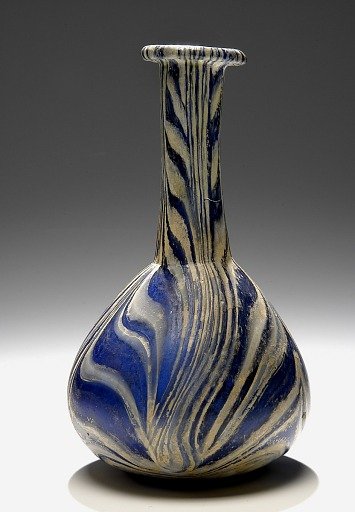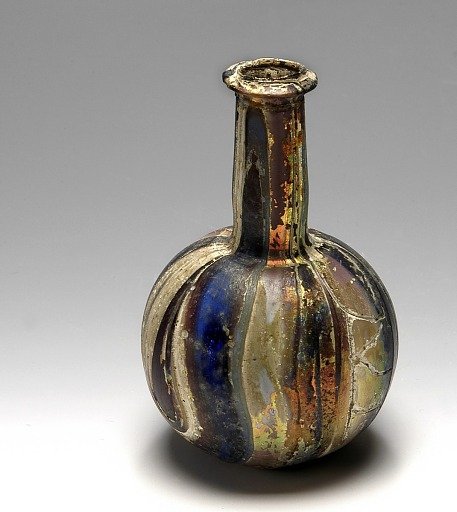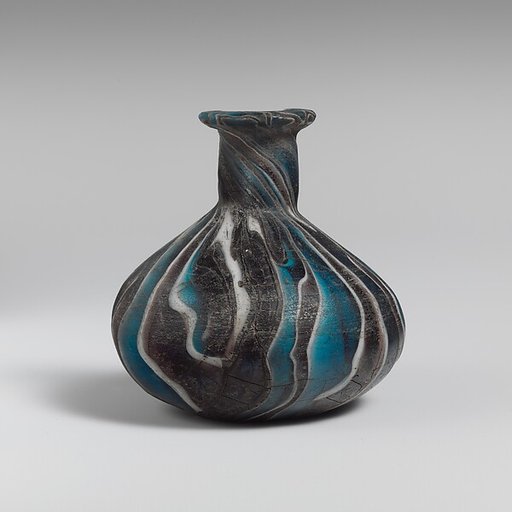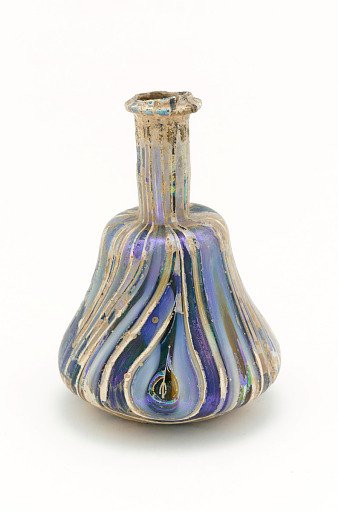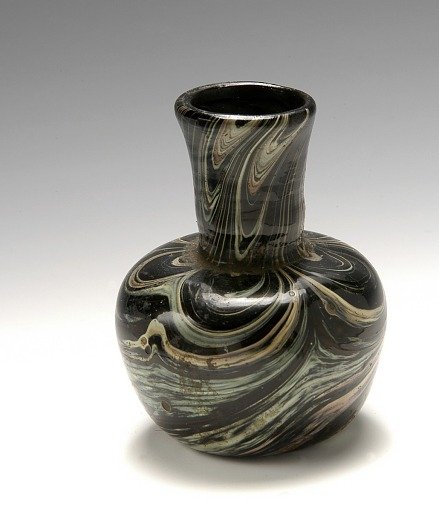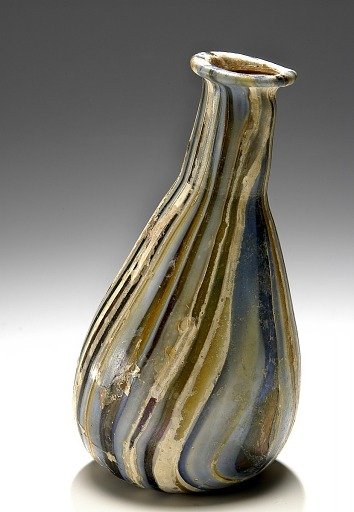
Flask
From the collection of Smithsonian American Art Museum. Free to download, adapt and use — no permission needed.
Most of the glass vessels in this case date from the first century BC to the fourth century AD. Early glass vessels were made in the Middle East and Egypt using the core-forming technique, in which molten glass was poured over a clay core and decorated with threads of colored glass. During the first century AD, Rome became the center of glassmaking, and the invention of blown glass led to new methods, including free-blown glass, which could be decorated by pinching, rolling, or dragging the surface, and mold-blown glass, in which the molten glass was blown into a terra-cotta mold. The Romans also developed stratified glass, in which different colored canes were fused together and blown <b>[see 1929.8.147.1, 1929.8.147.2]</b>, and millefiori glass (Italian for “one-thousand flowers”), in which colored strips of glass were joined together into a rod, cut into slices, and fused into bowls and cups <b>[see 1929.8.147.13, 1929.8.157.9]</b>. Many glass vessels were buried in the tombs of wealthy Romans and this contact with damp soil over hundreds of years caused the surface of the glass to deteriorate and become iridescent <b>[see 1929.8.147.37, 1929.8.157.22]</b>.
Smithsonian American Art Museum’s own description