CC0 · no rights reserved
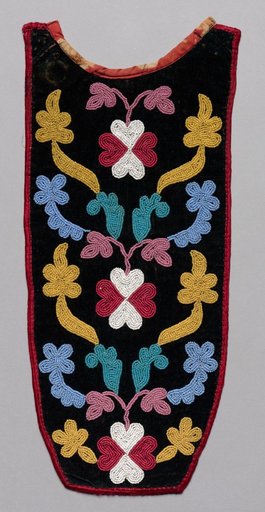
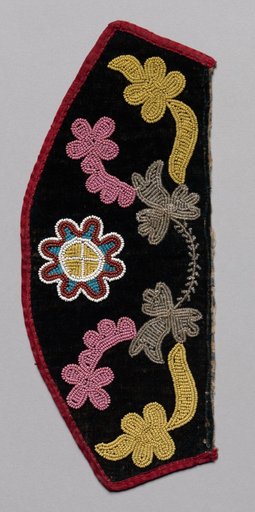
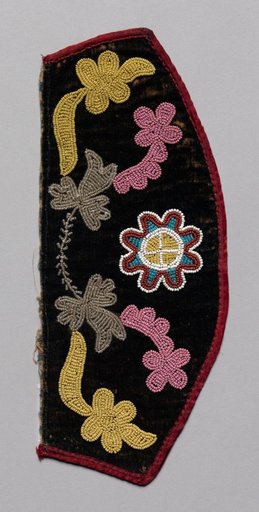
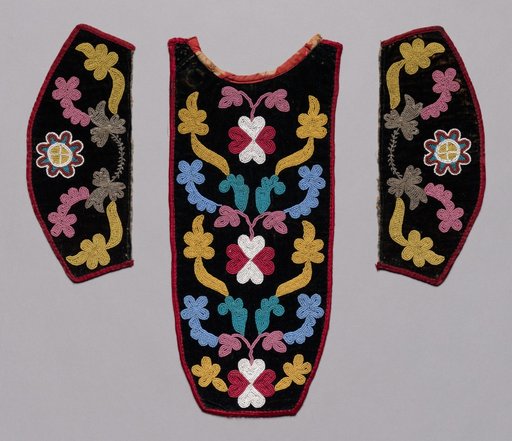
Placket and Cuffs
From the collection of Cleveland Museum of Art. Free to download, adapt and use — no permission needed.
About this work
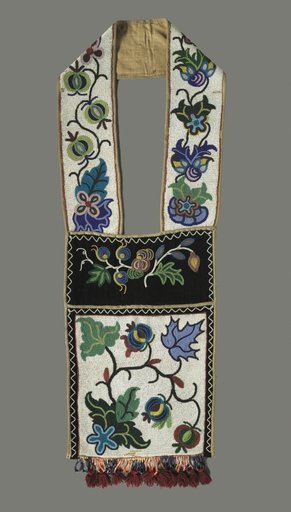
In the 1800s, native peoples began to use European fabrics to fashion fine formal garments; they favored sturdy cloth, such as velvet and wool broadcloth, which provided support for heavy decorative beadwork that was added by hand. Often the fabric was a dark color, providing dramatic contrast for the multicolored beads. Rather than encrusting the entire garment, beadwork was confined to cuffs, “epaulettes,” bib-like plackets and yokes, rectangular panels sewn to leggings, shirts, and dresses, and the like.
Cleveland Museum of Art’s own descriptionCredit linePlacket and Cuffs, late 1800s. Northeast Woodlands, Great Lakes Region, Anishinaabe (Ojibwe) or Nehiyawak (Cree) People?. Velvet, cotton; overall: 19.2 cm (7 9/16 in.); average: 12.5 x 30 cm (4 15/16 x 11 13/16 in.). The Cleveland Museum of Art, Anonymous gift in memory of Sarah Ann Morrison, 1956.788