CC0 · no rights reserved
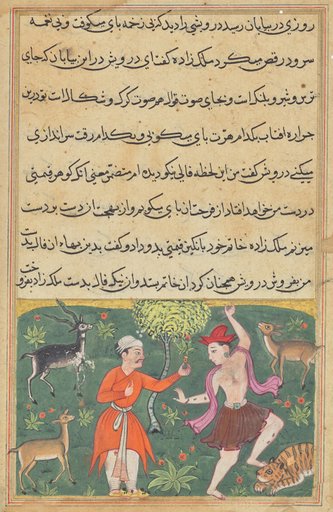
The prince meets a carefree dancing dervish whose good fortune he purchases for his ring, from a Tuti-nama (Tales of a Parrot): Eighteenth Night
From the collection of Cleveland Museum of Art. Free to download, adapt and use — no permission needed.
About this work
The prince, in the orange tunic, had been exiled by his older brother who inherited the throne, so he decided to travel the country. In a wilderness he met a dancing dervish to whom wild animals seemed mystically drawn; the deer are unconcerned about the tiger nearby. Dervishes are Sufi holy men whose dances bring them closer to god, but in this ironic story, the dervish dances for joy, because he just perceived an omen that he was about to become rich. The prince handed him his signet ring in exchange for the dervish’s good fortune.
Cleveland Museum of Art’s own descriptionCredit lineThe prince meets a carefree dancing dervish whose good fortune he purchases for his ring, from a Tuti-nama (Tales of a Parrot): Eighteenth Night, c. 1560. Mughal India, court of Akbar (reigned 1556–1605). Gum tempera, ink, and gold on paper; overall: 20.3 x 14 cm (8 x 5 1/2 in.); painting only: 6.9 x 10.5 cm (2 11/16 x 4 1/8 in.). The Cleveland Museum of Art, Gift of Mrs. A. Dean Perry, 1962.279.131.b
Similar works
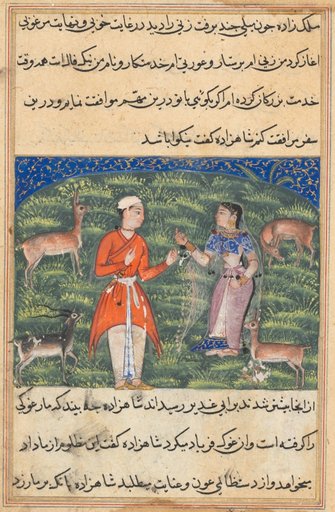 Nikfal, the fortune of the prince in the form of a woman, offers to accompany him, from a Tuti-nama (Tales of a Parrot): Eighteenth Night
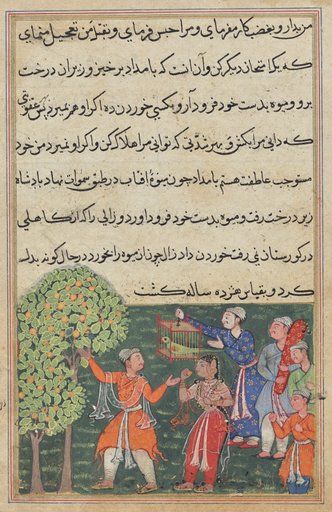 The king plucks fruit from the Tree of Life with his own hands and feeds it to a lady, from a Tuti-nama (Tales of a Parrot): Ninth Night
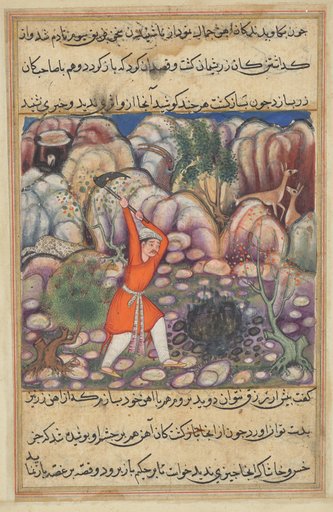 The fourth man digs at the spot where he dropped the shell, expecting jewels, but discovering mere iron, from a Tuti-nama (Tales of a Parrot): Forty-seventh Night
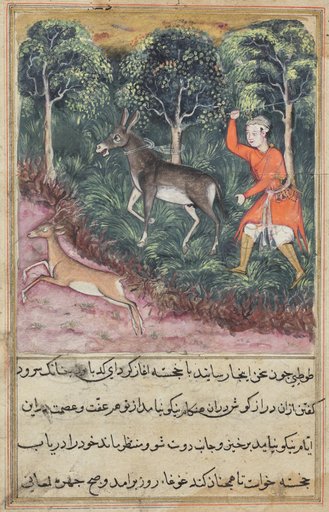 The gardener seizes and beats a donkey who insisted on braying, while the deer, its companion flees to safety, from a Tuti-nama (Tales of a Parrot): Forty-first Night
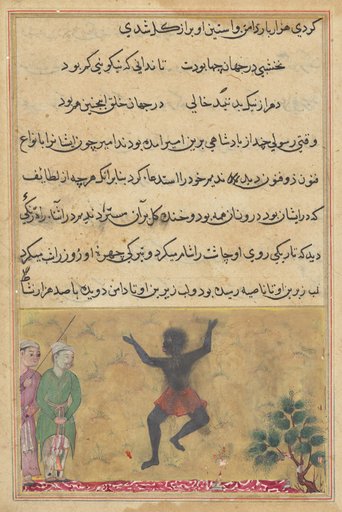 The court jester meets a Zangi dancing with joy, and learns from him that the cause of his happiness is his assignation with a woman who is the jester’s own wife, from a Tuti-nama (Tales of a Parrot): Twenty-second Night
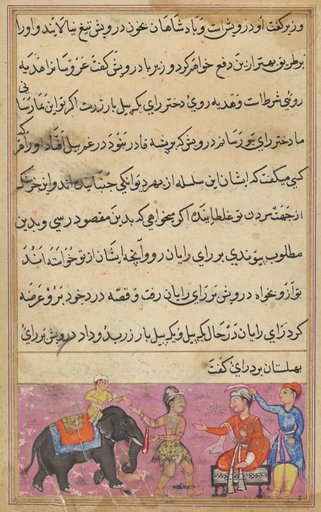 The dervish brings in as dowry an elephant laden with gold, from a Tuti-nama (Tales of a Parrot): Seventh Night