CC0 · no rights reserved
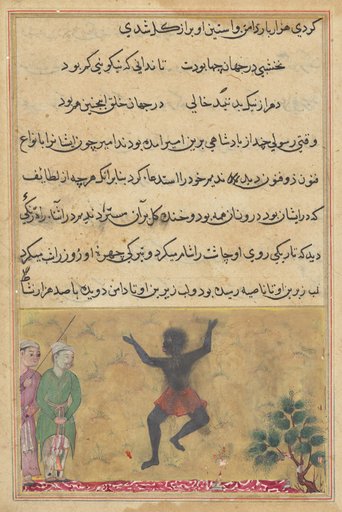
The court jester meets a Zangi dancing with joy, and learns from him that the cause of his happiness is his assignation with a woman who is the jester’s own wife, from a Tuti-nama (Tales of a Parrot): Twenty-second Night
From the collection of Cleveland Museum of Art. Free to download, adapt and use — no permission needed.
About this work
In the opening scene of the parrot’s bawdy story about a jester, who is shown wearing green on his way to perform at the court of the emir, he came upon an Ethiopian, known as Zangi, dancing by the side of the road. When he learned that the Zangi was overjoyed because he was planning to meet his beloved, the jester’s own wife, the jester was so distraught he was unable to perform, and the emir threw him in prison. The artist depicted the Zangi as described in the text as semi-wild with caricatured physical traits, uncovered head, and little clothing.
Cleveland Museum of Art’s own descriptionCredit lineThe court jester meets a Zangi dancing with joy, and learns from him that the cause of his happiness is his assignation with a woman who is the jester’s own wife, from a Tuti-nama (Tales of a Parrot): Twenty-second Night, c. 1560. Mughal India, court of Akbar (reigned 1556–1605). Gum tempera, ink, and gold on paper; overall: 20.3 x 14 cm (8 x 5 1/2 in.); painting only: 6.1 x 10.2 cm (2 3/8 x 4 in.). The Cleveland Museum of Art, Gift of Mrs. A. Dean Perry, 1962.279.155.a
Similar works
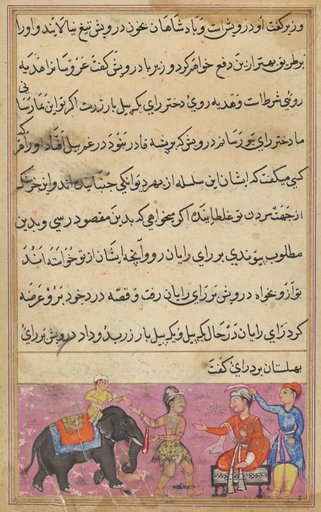 The dervish brings in as dowry an elephant laden with gold, from a Tuti-nama (Tales of a Parrot): Seventh Night
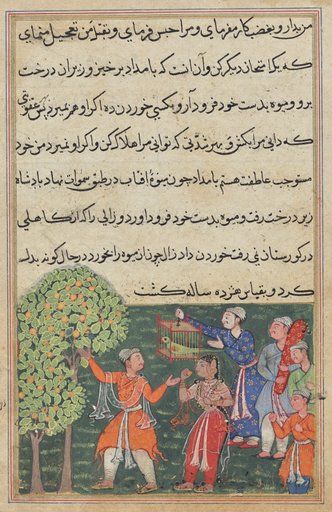 The king plucks fruit from the Tree of Life with his own hands and feeds it to a lady, from a Tuti-nama (Tales of a Parrot): Ninth Night
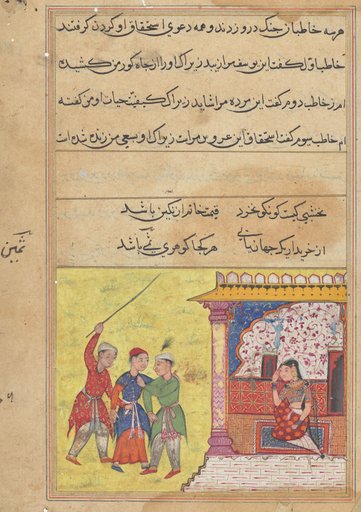 The three suitors again begin to quarrel among themselves for the hand of the devotee’s daughter, from a Tuti-nama (Tales of a Parrot): Twentieth Night
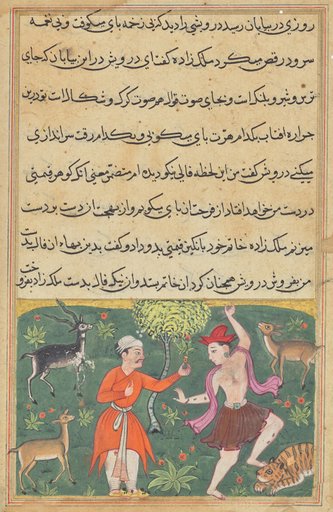 The prince meets a carefree dancing dervish whose good fortune he purchases for his ring, from a Tuti-nama (Tales of a Parrot): Eighteenth Night
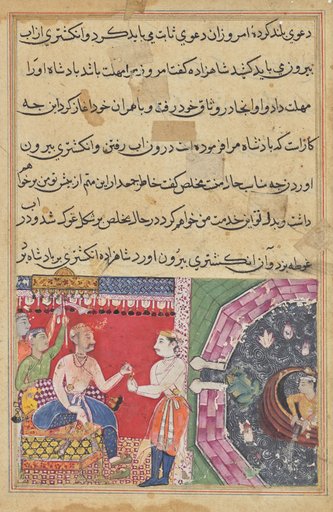 The prince, with the help of Mukhlis who changes into a frog, recovers the ring lost in the sea, and returns it to the king, from a Tuti-nama (Tales of a Parrot): Eighteenth Night
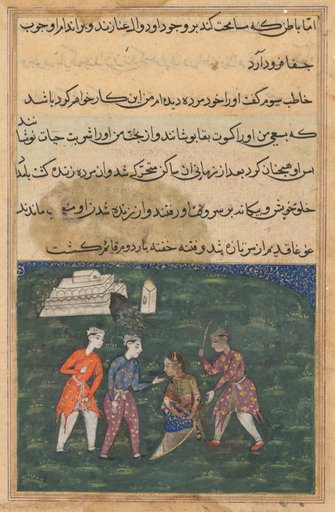 The third suitor strikes the devotee’s daughter and thus restores her to life, from a Tuti-nama (Tales of a Parrot): Twentieth Night