CC0 · no rights reserved
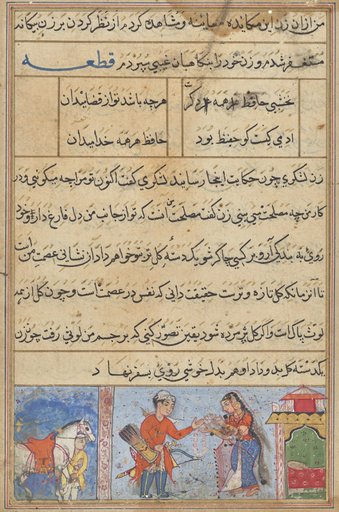
The soldier receives a garland of roses from his wife which will remain fresh as long as she is faithful, from a Tuti-nama (Tales of a Parrot): Fourth Night
From the collection of Cleveland Museum of Art. Free to download, adapt and use — no permission needed.
About this work
Upon his departure, a warrior’s wife gives him roses that stay fresh as long as she remains faithful in his absence. This story reveals a connection between virtue and nature: the flowers remain fresh because of her loyalty. The stories in the Tuti-nama reveal the interconnectedness of Indian, Persian, and Central Asian populations. The Persian retellings of Sanskrit tales found in this manuscript were completed in 1330 by the learned Central Asian Sufi author Ziya’ al-din Nakshabi working in Delhi, the capital of India. Indian and Persian artists worked together to illustrate this copy for the Mughal emperor Akbar.
Cleveland Museum of Art’s own descriptionCredit lineThe soldier receives a garland of roses from his wife which will remain fresh as long as she is faithful, from a Tuti-nama (Tales of a Parrot): Fourth Night, c. 1560. Mughal India, court of Akbar (reigned 1556–1605). Gum tempera, ink, and gold on paper; painting only: 3.8 x 10.6 cm (1 1/2 x 4 3/16 in.); overall: 20 x 14.3 cm (7 7/8 x 5 5/8 in.). The Cleveland Museum of Art, Gift of Mrs. A. Dean Perry, 1962.279.27.a
Similar works
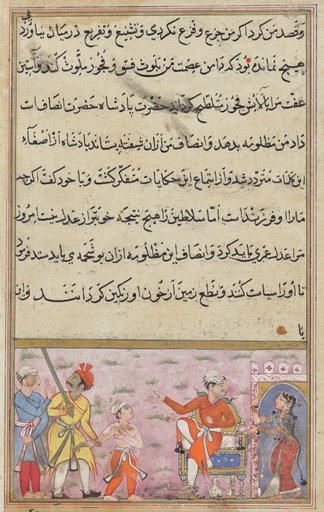 The prince being taken away for execution on the false complaint of the handmaiden, from a Tuti-nama (Tales of a Parrot): Eighth Night
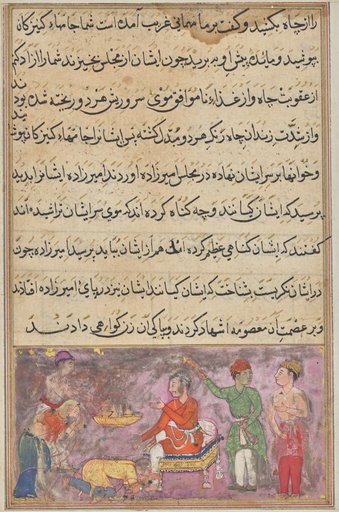 The two erring cooks, dressed as maidservants, fall at the prince’s feet and beg forgiveness, from a Tuti-nama (Tales of the Parrot): Fourth Night
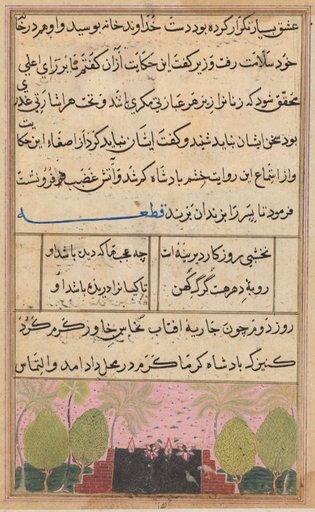 Landscape with a lotus pool, from a Tuti-nama (Tales of a Parrot), Eighth Night
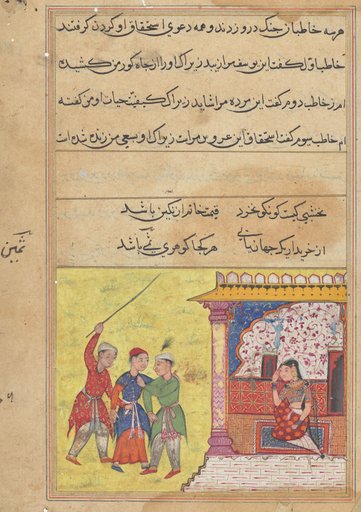 The three suitors again begin to quarrel among themselves for the hand of the devotee’s daughter, from a Tuti-nama (Tales of a Parrot): Twentieth Night
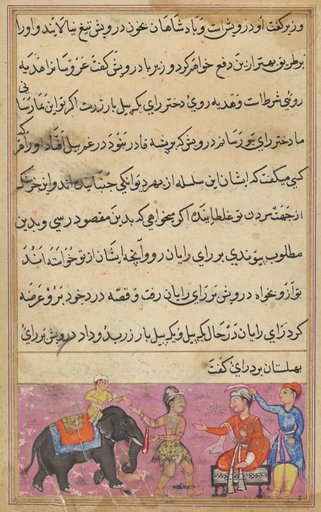 The dervish brings in as dowry an elephant laden with gold, from a Tuti-nama (Tales of a Parrot): Seventh Night
 Page from Tales of a Parrot (Tuti-nama): text page