CC0 · no rights reserved
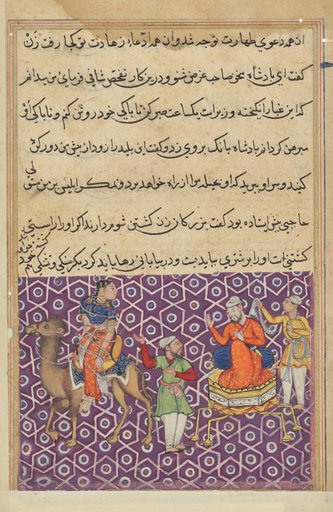
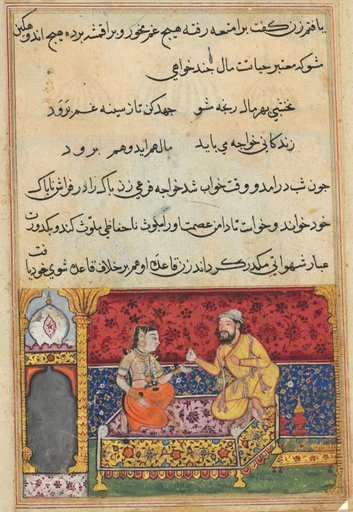
King Bahram, who has married Khassa’s daughter, has her tied to a camel to be abandoned in the desert as a result of false accusations made by Khulasa, from a Tuti-nama (Tales of a Parrot): Fifty-first Night
From the collection of Cleveland Museum of Art. Free to download, adapt and use — no permission needed.
About this work
The king, seated on a long-legged throne, furiously orders his wife’s execution. Khulasa, the king’s vizier, has attempted and failed to seduce her. Spurned by the queen’s rejection, he accuses her of committing adultery with another member of the court. At the center of the scene, a minister implores the king to abandon his wife, rather than have her beheaded.
Cleveland Museum of Art’s own descriptionCredit lineKing Bahram, who has married Khassa’s daughter, has her tied to a camel to be abandoned in the desert as a result of false accusations made by Khulasa, from a Tuti-nama (Tales of a Parrot): Fifty-first Night, c. 1560. Mughal India, court of Akbar (reigned 1556–1605). Gum tempera, ink, and gold on paper; overall: 20.3 x 14 cm (8 x 5 1/2 in.); painting only: 7.4 x 10.3 cm (2 15/16 x 4 1/16 in.). The Cleveland Museum of Art, Gift of Mrs. A. Dean Perry, 1962.279.328.a
Similar works
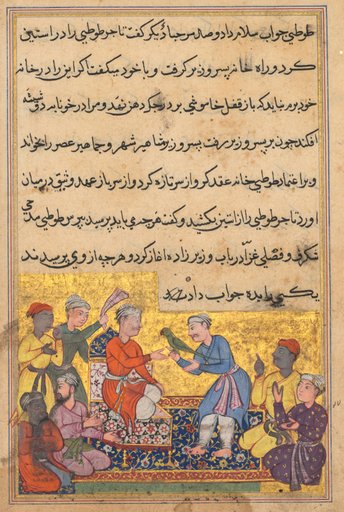 The magic parrot of the merchant talks to the vizier’s son, from a Tuti-nama (Tales of a Parrot): Tenth Night
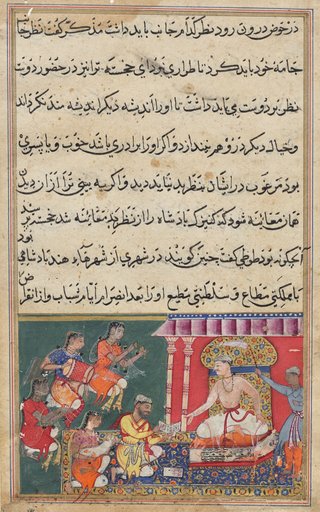 The astrologer predicts a calamity for the newly born prince in his thirteenth year, but one which he would be able to overcome, from a Tuti-nama (Tales of a Parrot): Eighth Night
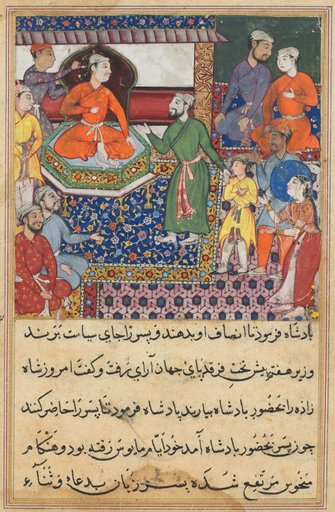 The handmaiden again pleads for the death of the prince, from a Tuti-nama (Tales of a Parrot): Eighth Night
 The young man changes himself to look like Mansur, and thus inveigles himself into the bed of Mansur’s wife, but is put off by her, from a Tuti-nama (Tales of a Parrot): Seventeenth Night
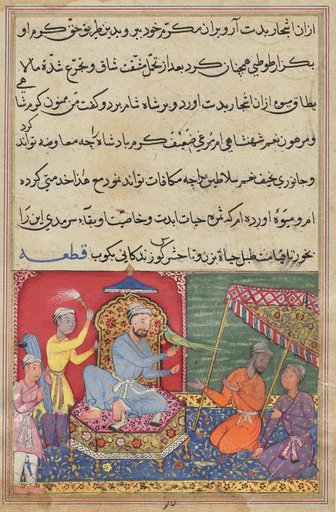 The parrot brings a fruit from the Tree of Life to the king of Syria, from a Tuti-nama (Tales of a Parrot): Ninth Night
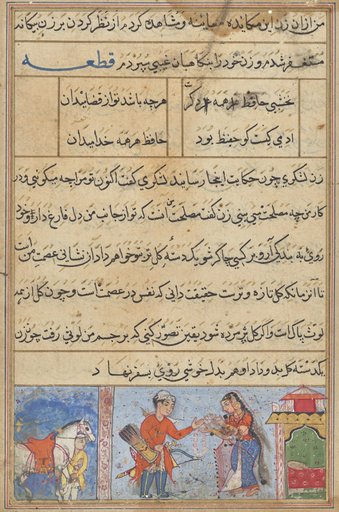 The soldier receives a garland of roses from his wife which will remain fresh as long as she is faithful, from a Tuti-nama (Tales of a Parrot): Fourth Night