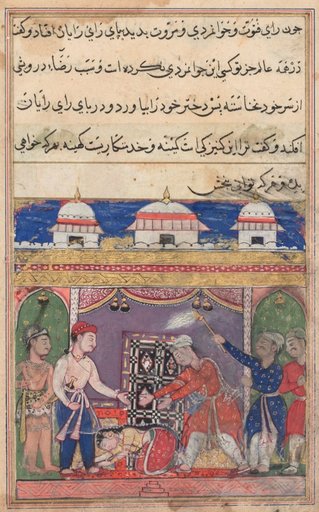
The king of Bahilistan offers his daughter to the King of Kings, from a Tuti-nama (Tales of a Parrot): Seventh Night
From the collection of Cleveland Museum of Art. Free to download, adapt and use — no permission needed.
The local king was so moved by the gesture of the King of King’s in support of the dervish and by his cleverness at bringing his own head, still attached, that he offered his daughter in marriage to him. The princess, wearing Indian dress, is shown honoring his feet. The male figures wear the Central Asian dress of the Mughals, with a long belted tunic and pants. The King of Kings then allowed her to marry the dervish. A fancy door with geometric patterns is in the background, but it extends all the way down to the front of the floor, which has been tilted up, so that the tile pattern can be seen head-on. These fanciful manipulations of space are a hallmark of local Indian artistic practice.
Cleveland Museum of Art’s own descriptionSimilar works
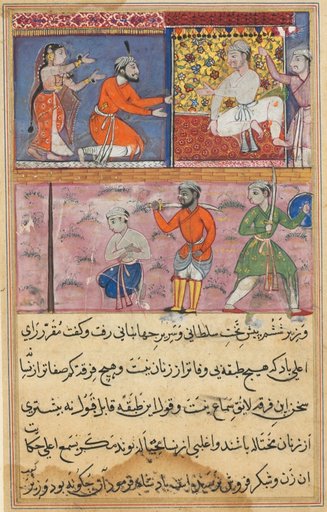 The prince sent back to the place of execution for the sixth time, from a Tuti-nama (Tales of a Parrot): Eighth Night
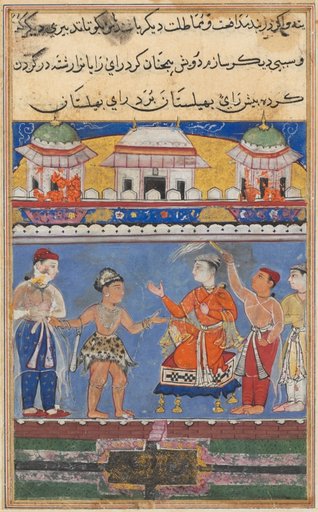 The dervish brings the King of Kings before the king of Bahilistan, from a Tuti-nama (Tales of a Parrot): Seventh Night
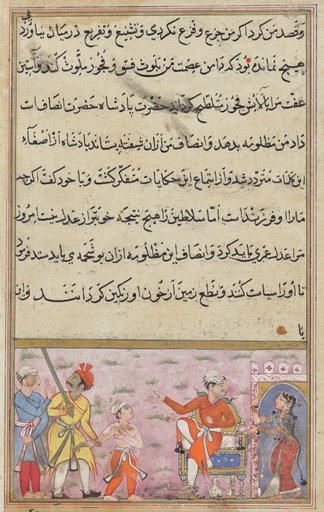 The prince being taken away for execution on the false complaint of the handmaiden, from a Tuti-nama (Tales of a Parrot): Eighth Night
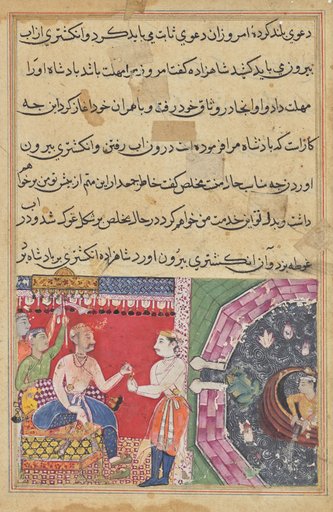 The prince, with the help of Mukhlis who changes into a frog, recovers the ring lost in the sea, and returns it to the king, from a Tuti-nama (Tales of a Parrot): Eighteenth Night
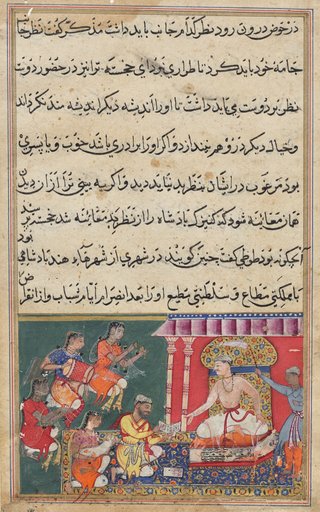 The astrologer predicts a calamity for the newly born prince in his thirteenth year, but one which he would be able to overcome, from a Tuti-nama (Tales of a Parrot): Eighth Night
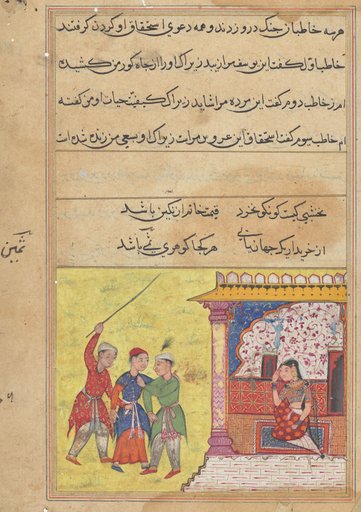 The three suitors again begin to quarrel among themselves for the hand of the devotee’s daughter, from a Tuti-nama (Tales of a Parrot): Twentieth Night