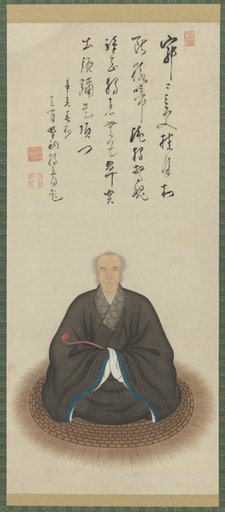
Portrait of Duli Xingyi
From the collection of Cleveland Museum of Art. Free to download, adapt and use — no permission needed.
In this portrait, the Ōbaku school Buddhist monk Duli Xingyi (born Tai Li, 1596–1672), whose name is pronounced Dokuryū Shōeki in Japanese, sits upon a woven mat holding a ceremonial scepter known as a ruyi , or nyoi in Japanese. Above his head is an insciption he added to the painting in 1671, the year before his death. It may be translated to read: Contemplative emptiness: the moon suspended over the village at midnight. Suddenly my soul is startled by the howl of an ape. Who could know that it would arouse me beyond my senses, and bring me an inner vision from Mt. Sumeru. (translated by Stephen Addiss and Kwan S. Wong) Originally from what is now the city of Hangzhou in China, Duli emigrated to Japan in 1653, where he took monastic vows. His skills in calligraphy and seal carving were formidable. Painter Kita Genki combined Chinese brush styles he learned in Nagasaki with Western painting techniques to capture Duli's likeness.
Cleveland Museum of Art’s own descriptionSimilar works
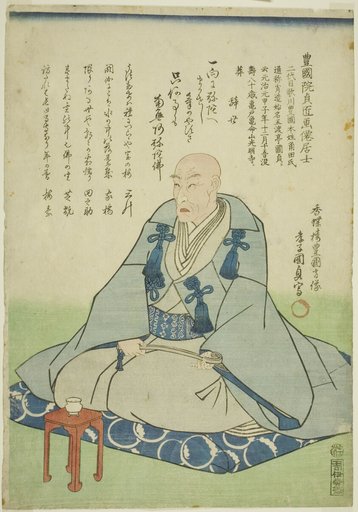 Memorial Portrait of Utagawa Kunisada I (Kochoro Toyokuni shozo)
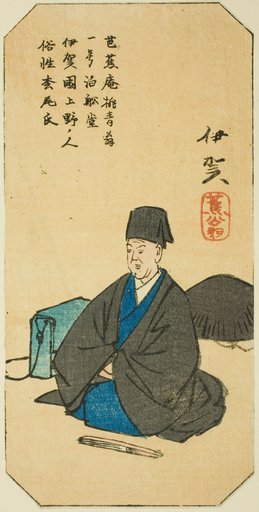 Iga, section of sheet no. 3 from the series "Cutout Pictures of the Provinces (Kunizukushi harimaze zue)"
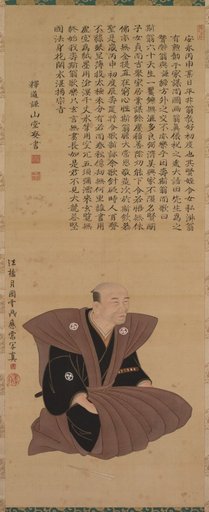 Portrait of Samurai-Official: Hirai KyoseiHirai Kyosei
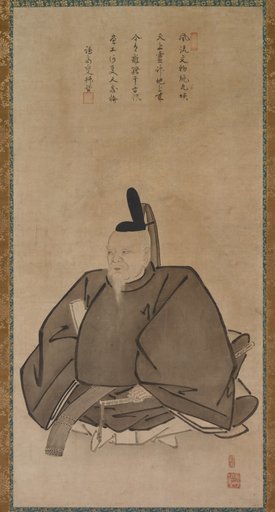 Portrait of Sugawara Michizane
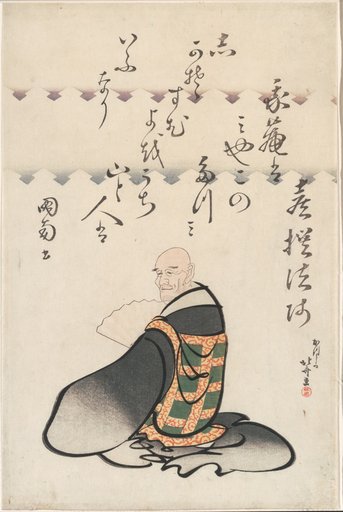 The Poet Kisen Hoshi, from the series Six Immortal Poets (Rokkasen)
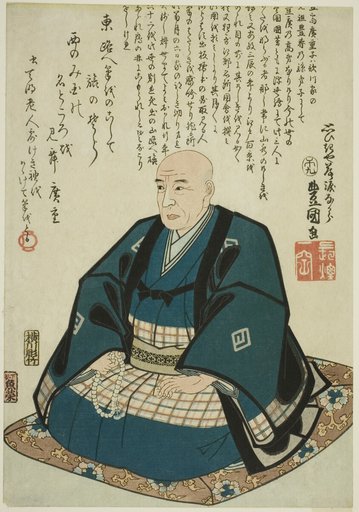 Memorial portrait of Utagawa Hiroshige