CC0 · no rights reserved
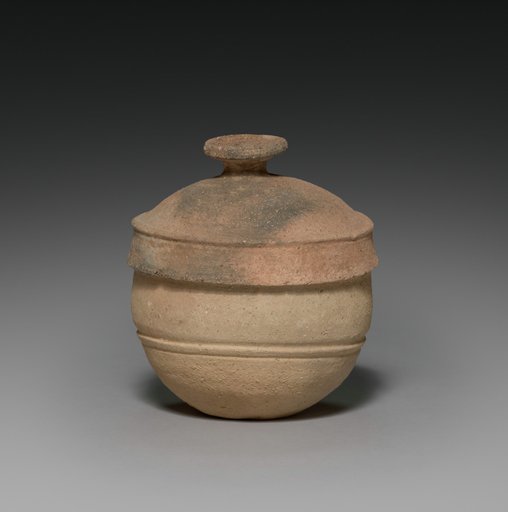
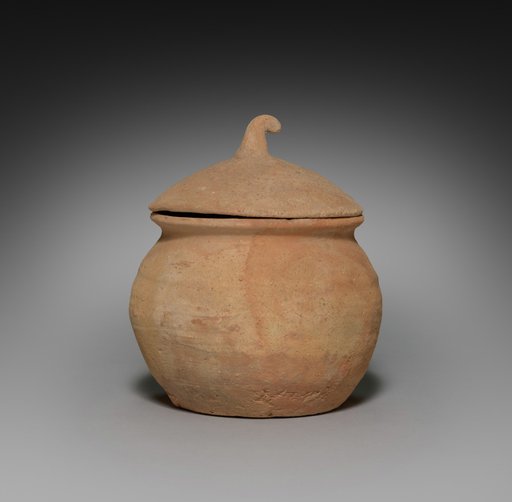
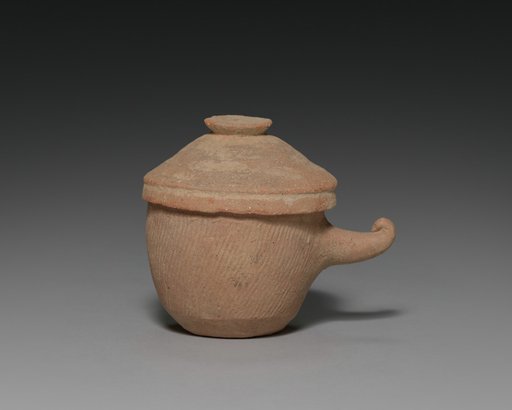
Lidded Jar with Horn Handle
From the collection of Cleveland Museum of Art. Free to download, adapt and use — no permission needed.
About this work
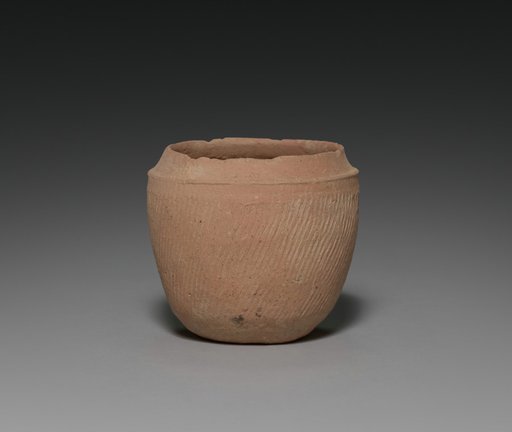
This type of pottery vessel was a product of closed kilns built on hillsides, which became widely used in Korea during the Three Kingdoms period. Its low-fired red surface indicates the various steps in its fabrication. First, coils of clay were layered on top of one another and pinched together to form the wall of the pot. Then wood mallets with carved surfaces pounded these walls simultaneously, inside and out, merging and thinning the clay bands. Thus the impressed designs visible on both the inner and outer surfaces were functional as well as decorative.
Cleveland Museum of Art’s own descriptionCredit lineLidded Jar with Horn Handle (소뿔형 뚜껑있는 합 [牛角形有蓋盒]), 400s–500s CE. Korea, Silla (57 BCE–935 CE) or Kaya (42–562 CE) period. Red earthenware with impressed designs and applied red slip; overall: 10.8 cm (4 1/4 in.); 9.1 cm (3 9/16 in.). The Cleveland Museum of Art, Gift of the John D. Proctor Foundation, 1997.21