CC0 · no rights reserved
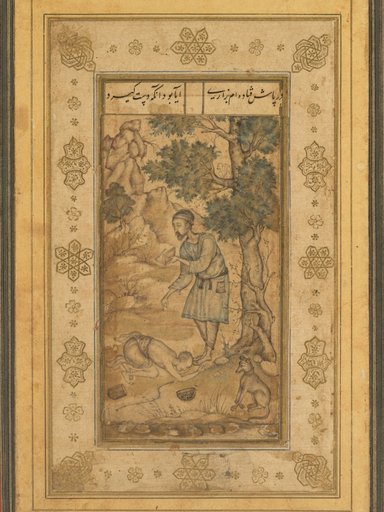
A mendicant bowing before a holy man, from the Prince Salim Album
From the collection of Cleveland Museum of Art. Free to download, adapt and use — no permission needed.
About this work
As the Mughal atelier grew into the 1580s, Indian artists become increasingly adept at incorporating Persian styles with a new dimensionality and naturalism that Akbar promoted, possibly based on his appreciation of European prints and paintings. Here, a sincere holy man wears robes tinged lightly with blue. He stands beneath a tree in the wilderness with a loyal jackal by his side. A devotee touches his head to his feet. The artist’s tiny signature is written on the alms bowl. Connoisseurs of Persian art in the Islamic world praised an artist’s virtuoso ability to work on a microscopic scale.
Cleveland Museum of Art’s own descriptionCredit lineA mendicant bowing before a holy man, from the Prince Salim Album, c. 1585; inner border added in Allahabad c. 1602; outer border added probably 1900s. Basavana (Indian, active c. 1560–1600). Gum tempera, ink, and gold on paper; page: 32.7 x 21.1 cm (12 7/8 x 8 5/16 in.); painting: 13.6 x 7.5 cm (5 3/8 x 2 15/16 in.). The Cleveland Museum of Art, Gift in honor of Madeline Neves Clapp; Gift of Mrs. Henry White Cannon by exchange; Bequest of Louise T. Cooper; Leonard C. Hanna Jr. Fund; From the Catherine and Ralph Benkaim Collection, 2013.296
Similar works
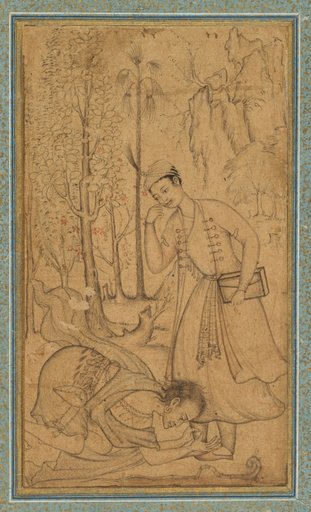 A holy man prostrating himself before a learned prince
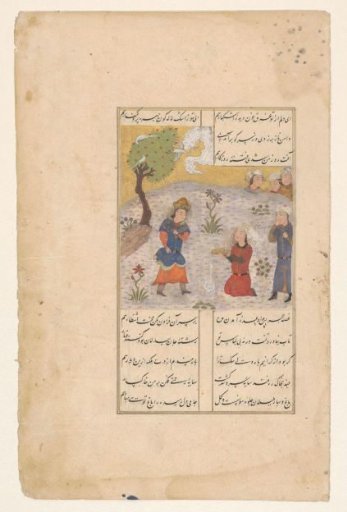 Prince receiving gifts
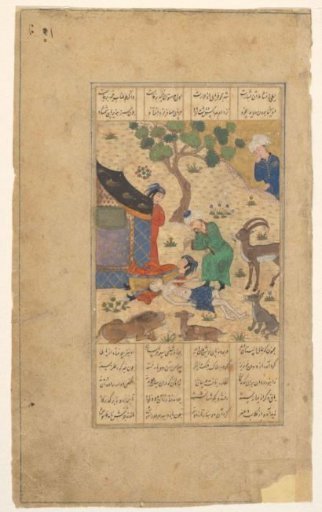 Laila and Mainum
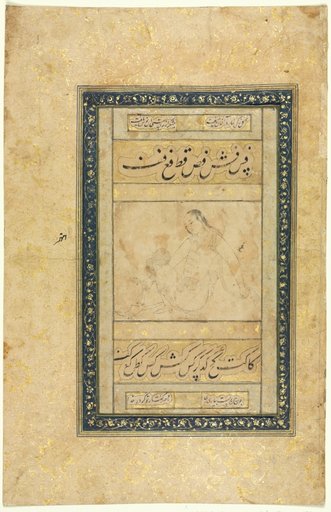 Sketch of a Young Man and Persian Calligraphy
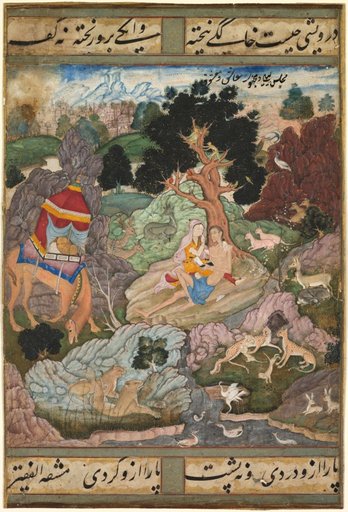 Layla and Majnun in the wilderness with animals, from a Khamsa (Quintet) of Amir Khusrau Dihlavi
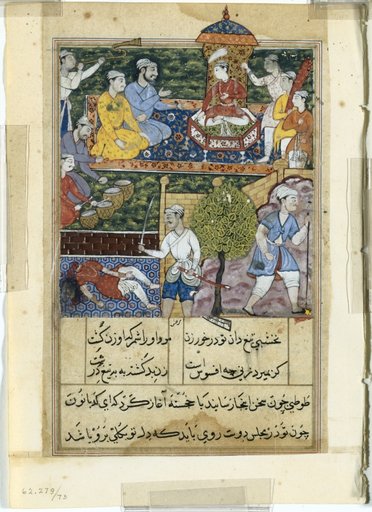 The young prince is crowned and the wicked handmaiden is executed, from a Tuti-nama (Tales of a Parrot): Eighth Night