CC0 · no rights reserved
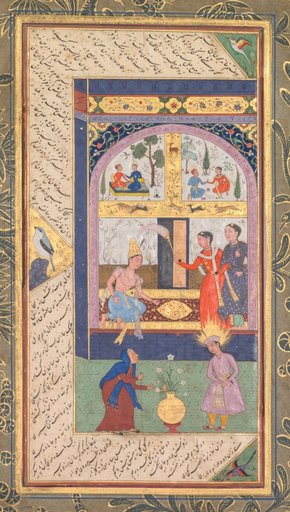
Zulaykha in her palace and as an elderly woman with Joseph (recto), from a Panj Ganj (Five Treasures) of Abd al- Rahman Jami (Persian, 1414–1492)
From the collection of Cleveland Museum of Art. Free to download, adapt and use — no permission needed.
About this work
The golden pot of white narcissus flowers at the bottom center of the painting signals that Zulaykha, leaning on her staff to the left, will imminently have her youth and beauty restored. In this Persian retelling of the Old Testament account from the Bible, Zulaykha lusted after Joseph, even though she was already married to Potiphar. Joseph, with the golden halo, resisted her advances until she became a widow and retained his youth, because of his extreme virtue. Above, Zulaykha as a young woman waits for Joseph in her house where murals of them as a happy couple are painted on the walls.
Cleveland Museum of Art’s own descriptionCredit lineZulaykha in her palace and as an elderly woman with Joseph (recto), from a Panj Ganj (Five Treasures) of Abd al- Rahman Jami (Persian, 1414–1492), 1603–7. Mushfiq (Indian, active early 1600s), Sultan 'Ali al-Mashadi (Iranian, 1430–1520). Gum tempera, ink, and gold on paper; text area: 17.8 x 9.5 cm (7 x 3 3/4 in.); page: 31.6 x 20.4 cm (12 7/16 x 8 1/16 in.). The Cleveland Museum of Art, Gift in honor of Madeline Neves Clapp; Gift of Mrs. Henry White Cannon by exchange; Bequest of Louise T. Cooper; Leonard C. Hanna Jr. Fund; From the Catherine and Ralph Benkaim Collection, 2013.315.1.a
Similar works
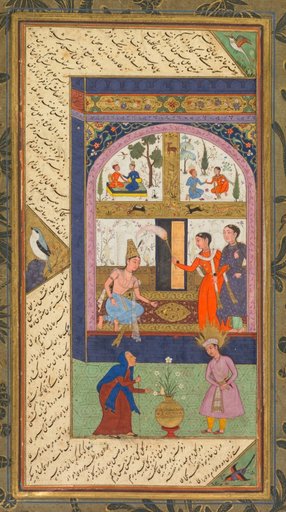 Folios A and B from the "Five Treasures" (Panj Ganj) of Jami
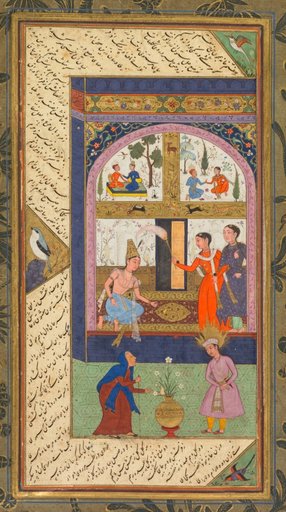 Zulaykha in her palace and as an old woman with Joseph, from a Panj Ganj (Five Treasures) of Abd al-Rahman Jami (Persian, 1414–1492); verso from a Panj Ganj of Abd al-Rahman Jami (Persian, 1414–1492), with two masnavis: Yusuf va Zulaykha (Joseph and Zulaykha) and Khirad-nama-i Iskandari (Alexander’s Book of Wisdom)
 John the Baptist recognizes Christ by the appearance of a dove (folio 50 verso), from a Mirror of Holiness (Mir’at al-quds) of Father Jerome Xavier
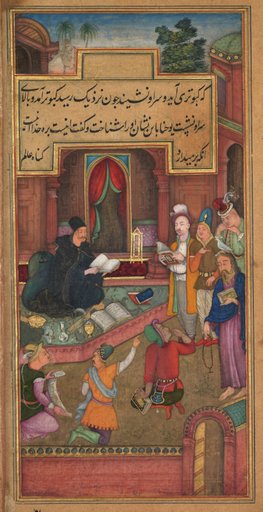
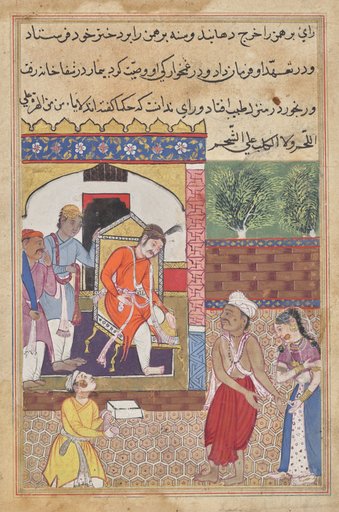 The magician, disguised as a Brahman, visits the king of Babylon, from a Tuti-nama (Tales of a Parrot): Thirty-fifth Night
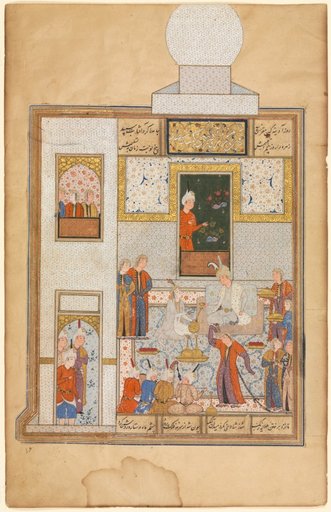 Bahram Visits the White Domed Pavilion on Friday, illustrated with text in Khamsa of Nizami (verso), from a Haft Paykar (Seven Portraits) of Nizami
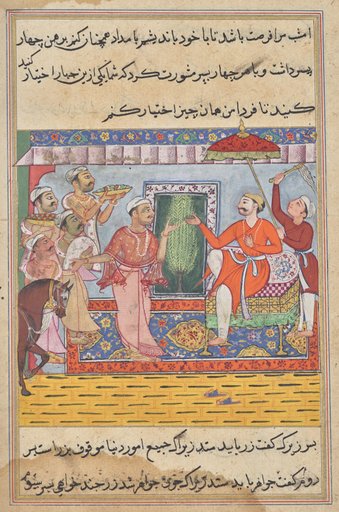 The Brahman, unable to select from the four gifts of the king of the Ocean seeks the Raja’s advice, from a Tuti-nama (Tales of a Parrot): Eleventh Night