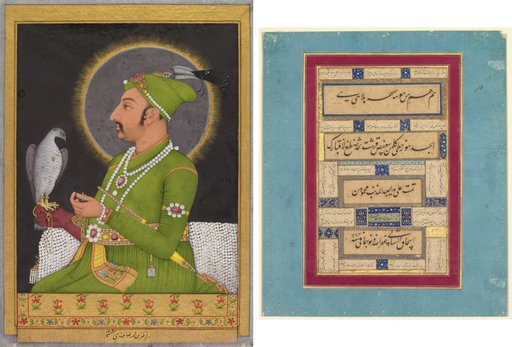
Posthumous portrait of the Mughal emperor Muhammad Shah (reigned 1719–1748) holding a falcon (recto); Calligraphy (verso)
From the collection of Cleveland Museum of Art. Free to download, adapt and use — no permission needed.
Emperor Muhammad Shah, who reigned from 1719 to 1748, was known as “Rangila,” which means “the Colorful.” The innovative use of a black background sharply sets off the chartreuse green of his jama and the pearls of his adornments and bolster. On his left thumb he wears an archer’s ring, and a stabbing dagger is tucked into his bejeweled belt. Even his trained hunting falcon has a ruby necklace. In this formal posthumous portrait, the master artist conveys a heightened realism that emerges effortlessly from elegant contour lines and bold use of color. The work was part of an album of paintings collected in India before 1811 by a Scottish politician who worked for the British East India Company.
Cleveland Museum of Art’s own descriptionSimilar works
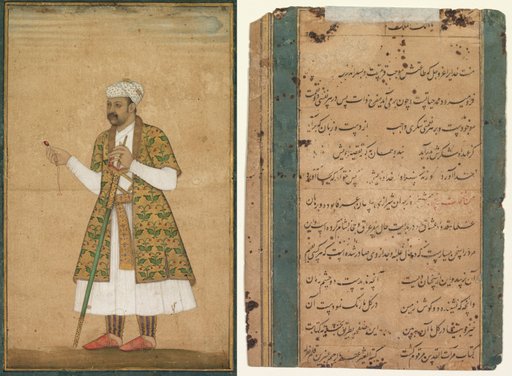 A Courtier, Possibly Khan Alam, Holding a Spinel and a Deccan Sword
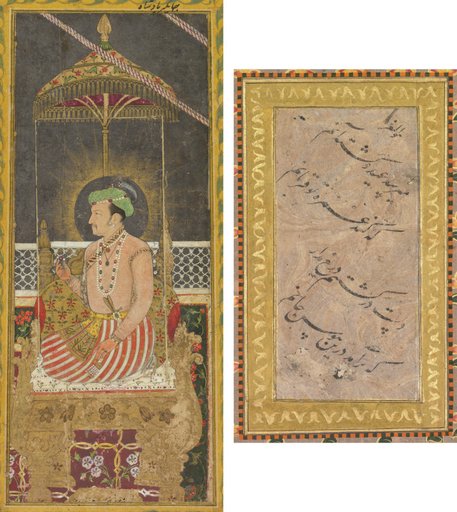 Posthumous portrait of Emperor Jahangir under a canopy (recto); Calligraphy (verso)
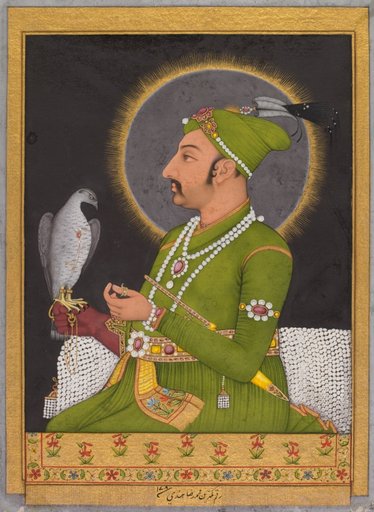 Posthumous portrait of the Mughal emperor Muhammad Shah (reigned 1719–1748) holding a falcon (recto)
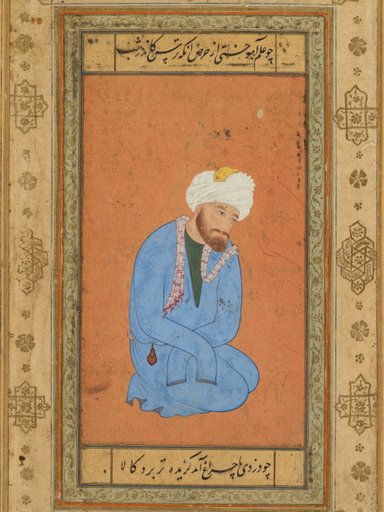 Portrait of a kneeling holy man, from the Prince Salim Album
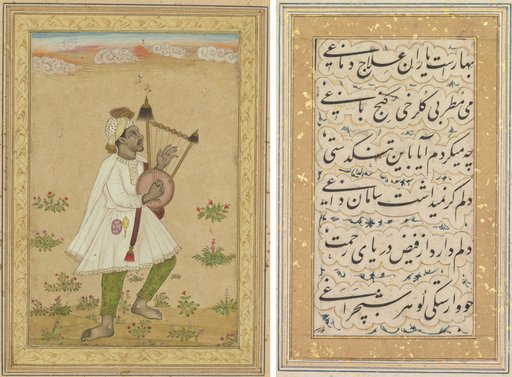 An African Lyre Player (recto); Calligraphy (verso)
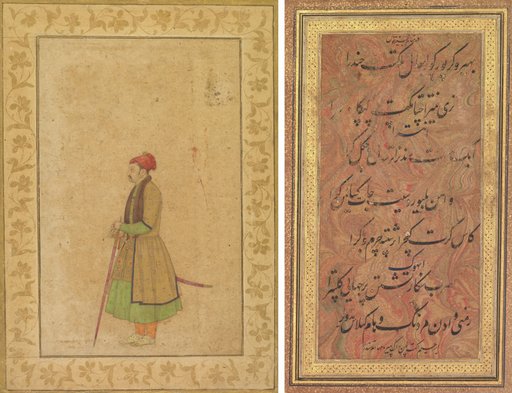 Portrait of Raja Ram Singh of Amber (r. 1667-1688) with a Deccan Sword (recto); Calligraphy (verso)