CC0 · no rights reserved
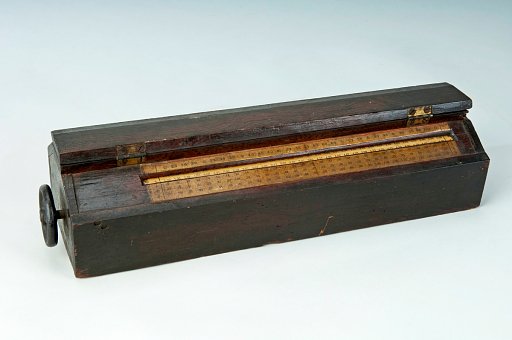
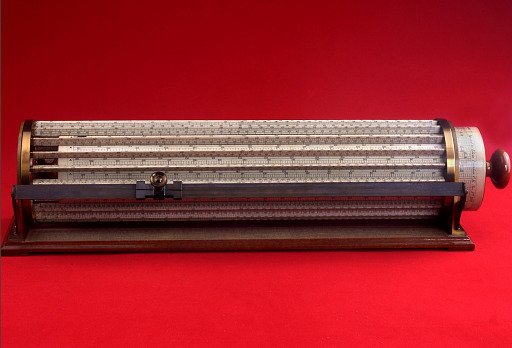
Keuffel & Esser 1741 Thacher Cylindrical Slide Rule
From the collection of National Museum of American History. Free to download, adapt and use — no permission needed.
About this work
In 1881, Edwin Thacher, a "computing engineer" for the Keystone Bridge Company in Pittsburgh, Pennsylvania, received a patent for an improvement in slide rules. Thacher, a graduate of Rennselaer Polytechnic Institute, spent much of his career designing railway bridges. To assist in his calculations, he designed a cylindrical slide rule. Thacher's rule, though it fit on a desk, was equivalent to a conventional slide rule over 59 feet long. The rule had scales for multiplication and division and another scale, with divisions twice as large, for use in finding squares and square roots. There were no trigonometric scales.
National Museum of American History’s own descriptionCredit lineKeuffel & Esser 1741 Thacher Cylindrical Slide Rule. 1890s. Stanley, William Ford. National Museum of American History, Transfer from Physics Department, U.S. Military Academy, Dept. of Defense. CC0.