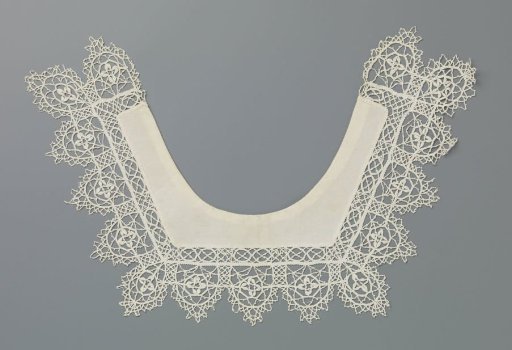
Collar of bobbin lace inspired by 17th-century falling collars and accompanying engagement photo (copy) of Bram Pleging and Jet Faber, who made the collar and wore it during her engagement
From the collection of Rijksmuseum, Amsterdam. Free to download, adapt and use — no permission needed.
Collar of linen with a border of natural-colored bobbin lace. Trapezium-shaped lying model, with U-shaped neckline. The repeating pattern consists of semi-oval shells, with in the center a four-lobed rosette of eight pointed oval leaves, made in buttonhole stitch. The rosette stands in the center of a braided wheel with eight points that form a star. The shells are finished with picoted point braids. The four corner shells, two back and two front, are egg-shaped inset. The whole is inspired by a type of lying collar, which was popular in the 17th century. The maker of the collar, Johanna Henriëtte Faber (Jet), succeeded Louise Van der Meulen-Nulle as lace teacher at the Rijkschool voor Kunstnijverheid in 1916. She wears the collar in that same year at her engagement to Abraham Pleging (Bram). The collar is seen in the photo, which was made on this occasion of the engaged couple and of which a copy was donated with the lace collar.
Rijksmuseum, Amsterdam’s own descriptionSimilar works
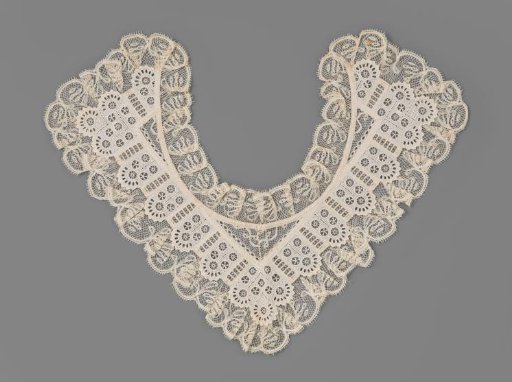 Collar with English embroidery and a strip of Valenciennes lace
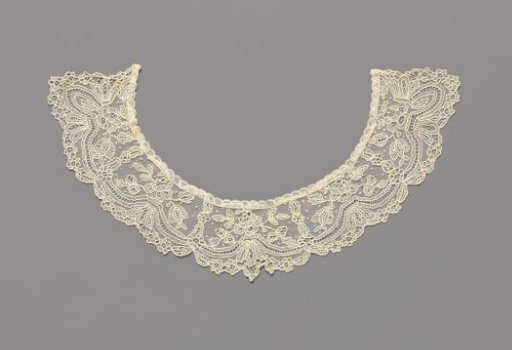 Collar of needle lace with symmetrical pattern of five rose fields
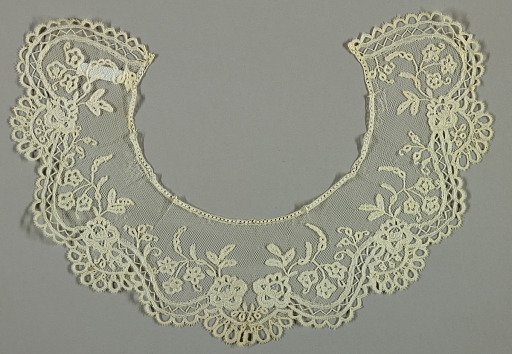 Collar
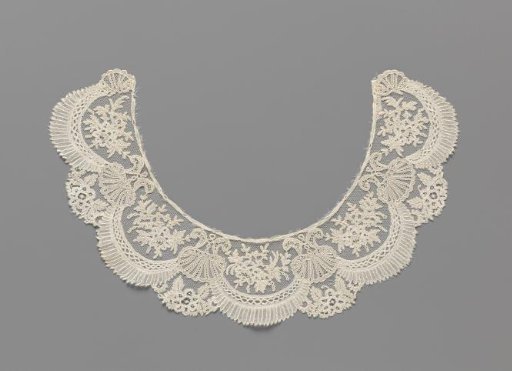 Collar of appliqué lace with five large shells between which four smaller ones with a rosette flower
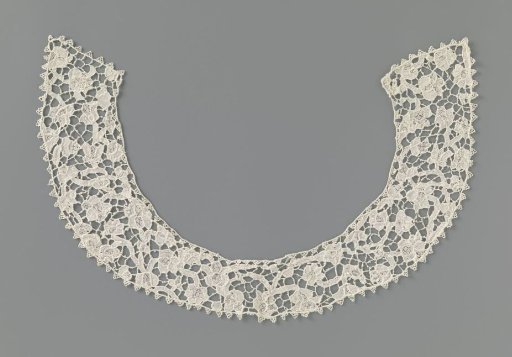 Round Collar with Many Flowers
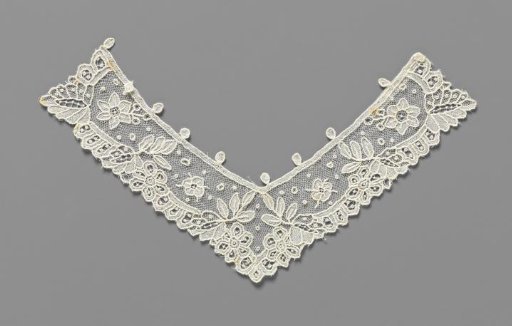 Cuff of Needle Lace with a V-Shaped Pattern