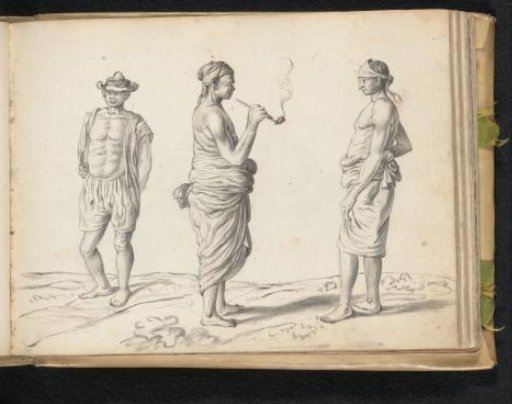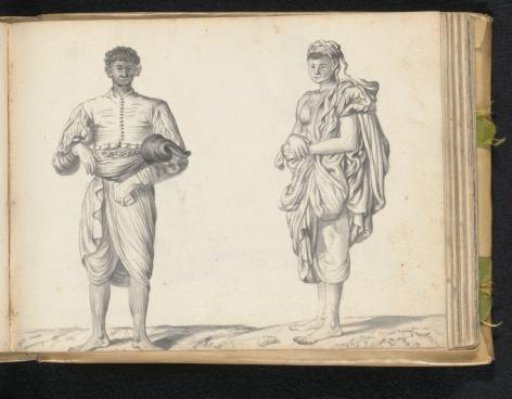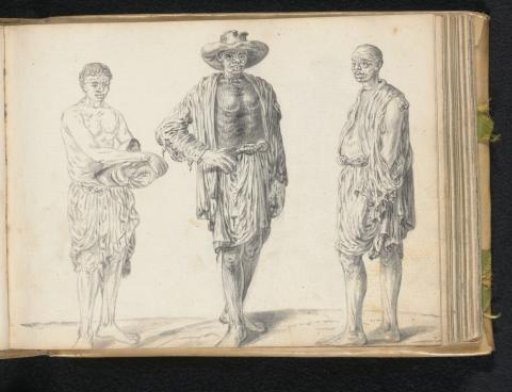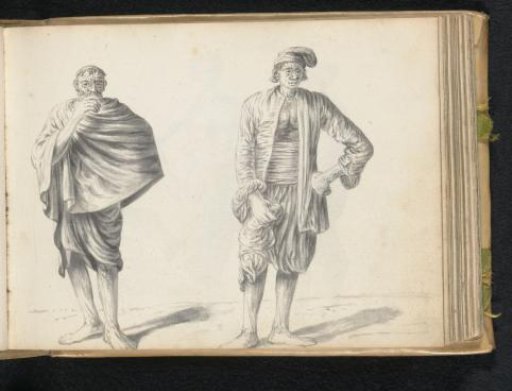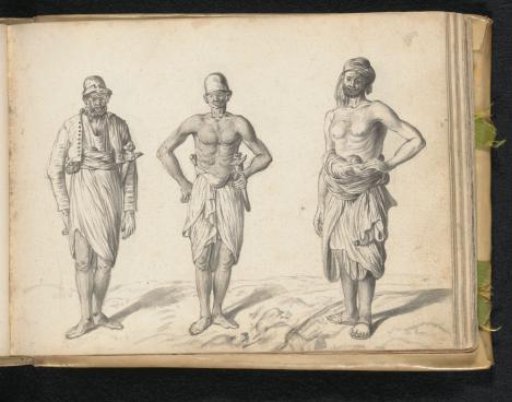
Two Sinhalese Soldiers and a Labourer
From the collection of Rijksmuseum, Amsterdam. Free to download, adapt and use — no permission needed.
On uneven ground outside three men are posing. The left man wears a knee-length hip-cloth (veshti, lungi), loosely tied in the waist with a waistband; an open short jacket with buttons and long sleeves (hettaya) and underneath a Portuguese shirt (kamisaya) with wide neck opening. On his left side hangs a short thrust weapon in a scabbard recognizable as a Javanese or Malay kris; the Dutch apparently also provided this type of weapon to members of their mercenary troops on Ceylon. On his head he wears a tall cap with incised turned-down edge. The man in the middle wears only a hip-cloth (veshti, lungi) wrapped in a Ceylonese manner. The upper body is bare. On his left side he also carries a kris. These two men are Ceylonese mercenaries (lascarijnen), now in service of the Dutch. They belong to the Goviya caste. The man on the right wears a hip-cloth (veshti, lungi) to far over the knees, and a second cloth (chadar) wrapped around his waist. The upper body is bare.
Rijksmuseum, Amsterdam’s own description